Regional Destination Guide
Local advice on Voroneț, Sucevița, Moldovița, Humor and Putna, the eight UNESCO Churches of Moldavia components, where to base yourself, transport and how many days the region actually deserves.
Neli Budeanu
Co-founder, DACO Private Travel · Former hospitality professional in Bucharest
Local travel knowledge based on living in Romania, working in hospitality and helping organise journeys for international visitors.
The essentials
The UNESCO eight
Arbore · Humor · Moldovița · Pătrăuți · Probota · St George in Suceava · Voroneț · Sucevița
Eight church components of the single World Heritage property known as Churches of Moldavia — celebrated for their exterior mural painting.
A note on terminology
“Painted monasteries of Bucovina” is a familiar tourism phrase. The official World Heritage property is called Churches of Moldavia, and it contains eight church components — not eight uniform monasteries.
Bucovina is one of those regions where one phrase becomes so successful that it begins to hide the place behind it.
The painted monasteries.
They are extraordinary.
They are also only the beginning.
Bucovina is a landscape of wooded hills and mountain edges, villages, active Orthodox communities, old Moldavian history, rural guesthouses, food, crafts and roads that connect churches whose walls have carried religious images for almost five centuries.
And even the phrase “painted monasteries” needs a little correction.
UNESCO does not list a property called “the eight painted monasteries of Bucovina”.
The World Heritage property is called Churches of Moldavia.
It contains eight church components.
Some belong to monastery complexes.
Some have different institutional histories.
One of Bucovina's most important monasteries — Putna — is not one of the eight at all.
That distinction may sound technical.
It actually makes planning Bucovina much easier.
You stop trying to collect monasteries.
You begin to understand a region.
Yes — particularly if religious art, medieval Moldavian history, rural landscapes and slower cultural travel interest you.
I would strongly consider Bucovina if you enjoy:
I would be less determined to include it if:
No destination is mandatory.
Bucovina is much better when curiosity brought you there.
| Question | My answer |
|---|---|
| Worth visiting? | Yes, especially for art, history and religious heritage |
| Main UNESCO property | Churches of Moldavia |
| Number of UNESCO components | 8 churches |
| Original inscription | 1993 |
| Sucevița added | 2010 |
| Best first base | Often Gura Humorului |
| Good transport gateway | Suceava |
| Best first stay | Around 3 nights |
| Can two nights work? | Yes |
| Bucharest day trip? | No |
| Need a car? | Not absolutely, but road transport is extremely useful |
| Is Putna one of the UNESCO eight? | No |
| Is Putna worth visiting? | Absolutely |
| Need to see all eight? | No |
The familiar tourism phrase is useful.
But it is imprecise.
The official UNESCO World Heritage property is called Churches of Moldavia.
These churches were built from the late fifteenth century to the late sixteenth century.
Their most remarkable characteristic is the way exterior walls were covered with extensive fresco cycles.
Not one decorative panel.
Not one saint above a doorway.
Entire façades.
Biblical scenes.
Saints.
Judgment.
Prayer.
Theology.
Narrative.
Colour.
UNESCO describes the paintings as systematic cycles covering the façades rather than simple decoration.
That is the key.
These churches were designed to communicate visually.
And the surrounding landscape is part of how we experience them today.
Eight.
The property contains:
Notice the wording.
Church.
Church.
Church.
This is why I prefer being precise.
Calling them all “eight monasteries” makes the geography and history sound simpler than it actually is.
Primary source
No.
Another detail frequently flattened by travel content.
Seven churches were inscribed in 1993.
The Church of the Resurrection at Sucevița Monastery was added in 2010.
UNESCO considered that extension to complete the series.
So if you see:
“the eight painted churches were listed in 1993,”
that is not quite correct.
Seven in 1993.
Sucevița in 2010.
Small distinction.
Better history.
Because they are not simply decoration placed outside.
They form large visual programmes connected with Orthodox Christian theology and the religious world of medieval Moldavia — complex visual theological programmes rather than ornamental wall paintings.
Imagine seeing these walls in the sixteenth century.
Many people could not read.
Books were expensive.
Printed religious images were not sitting inside everybody's house.
A painted church façade could communicate stories and ideas visually at monumental scale.
Today we tend to approach them as art.
They were also religious communication.
Remembering that changes the way you look.
No.
You can appreciate colour, composition, architecture and landscape without being an art historian or Orthodox Christian.
But a little context makes an enormous difference.
Instead of:
“beautiful old painting”,
you begin to recognise:
You do not need an exam.
You need enough explanation that the wall stops being wallpaper.
If somebody knows one Bucovina name, it is usually Voroneț.
That reputation is understandable.
The church dates from the reign of Stephen the Great and was built in 1488.
Its exterior painting is famous particularly for the monumental Last Judgment composition on the western façade.
And yes:
the intense blue associated with the paintings has become famous enough to acquire its own tourism vocabulary.
“Voroneț blue.”
Beautiful.
Memorable.
But I would not travel all the way to Bucovina simply to identify a colour.
Because it is a superb first lesson in how these churches work.
Architecture.
Paint.
Religious narrative.
Landscape.
Scale.
You can stand back and read an entire façade.
Then move closer and discover individual figures.
That change of scale is part of the experience.
Voroneț also has another practical advantage:
it is easy to integrate from Gura Humorului.
This makes it an obvious first stop for many travellers.
Obvious does not mean overrated.
Sometimes famous places are famous because they are very good.
It can be busy.
Particularly during:
That does not mean you need to avoid it.
Just understand that one of Romania's best-known religious heritage sites is unlikely to behave like a private chapel arranged for your arrival.
If quiet matters greatly:
timing matters.
But never let crowd avoidance become so obsessive that you miss the thing you came to see.
Close enough geographically to pair naturally with Voroneț, Humor immediately demonstrates why these monuments should not blur into one another.
The UNESCO component is the Church of the Assumption of the Virgin of the former Monastery of Humor.
The church dates from 1530.
Its exterior painting has its own visual identity, often remembered for warmer reddish tones.
But again:
colour is the mnemonic.
Not the whole story.
Architecture changes.
Composition changes.
The relationship with the surrounding monastic complex changes.
Once you have seen Voroneț and Humor with enough attention, you already understand something important:
“painted church” is a category.
Not a copy-and-paste design.
Humor works especially well because of its proximity to Gura Humorului and Voroneț.
Very reasonable.
Especially from Gura Humorului.
They fit geographically.
They complement one another.
And you still have room to:
eat;
walk;
look at the landscape;
actually think about what you saw.
This is a much better cultural day than eight hurried churches and a sandwich in the car.
Move west and the landscape begins to become an even stronger part of the experience.
Moldovița sits naturally within a Bucovina journey that begins to interact with the Carpathians.
The UNESCO component is the Church of the Annunciation of the Monastery of Moldovița.
It remains part of an active Orthodox monastic environment.
That final point matters.
You are not entering only a protected heritage site.
You are entering a place where religion is still practised.
Tourism and worship occupy the same space.
Visitors should behave accordingly.
Yes.
If you are interested in the subject.
This question is a little like:
“I saw one cathedral. Do I need another?”
Maybe.
Maybe not.
If architecture and religious art interest you, the differences become the reason to continue.
If after two churches you feel satisfied?
That is useful information too.
You do not need to continue until heritage becomes homework.
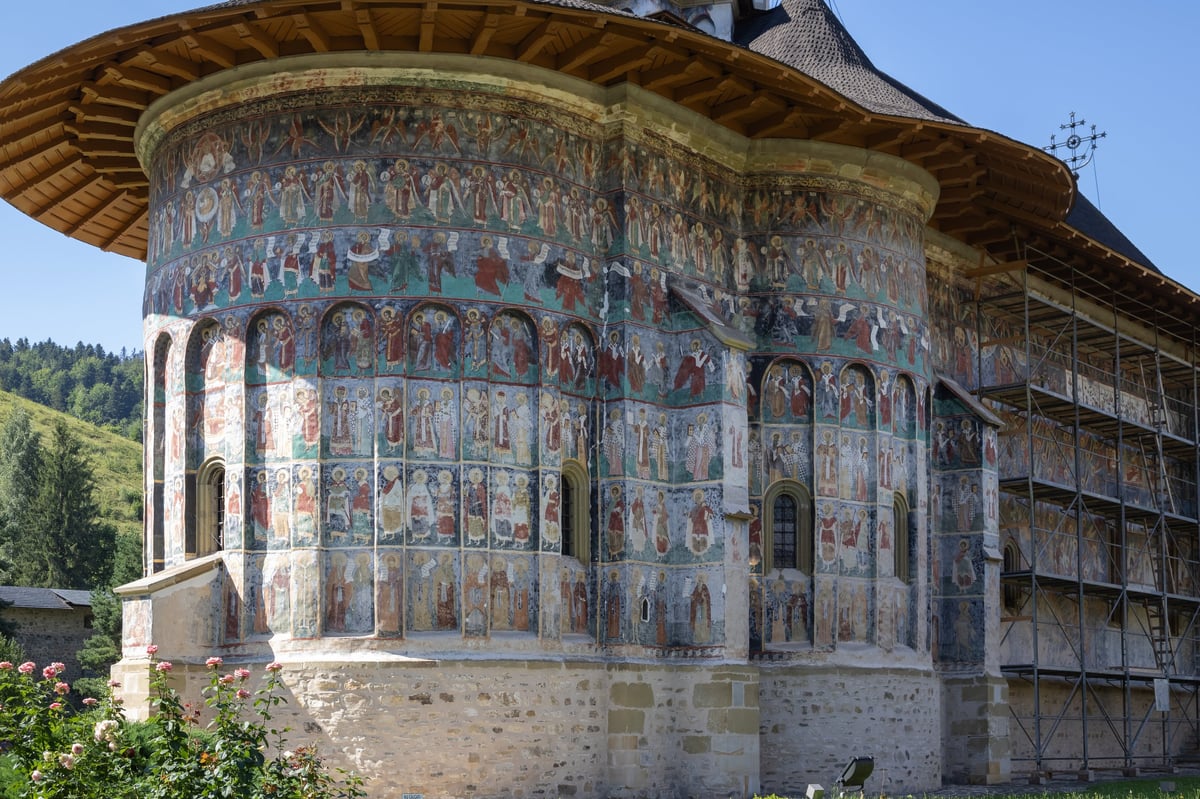
Sucevița often creates one of the strongest complete impressions of a Bucovina monastic site.
You approach a substantial fortified monastic complex.
Walls.
Towers.
Landscape.
Then the painted church inside.
The UNESCO component is specifically the Church of the Resurrection of Sucevița Monastery.
And remember:
this is the church that joined the World Heritage property in 2010.
Not 1993.
Among the enormous painted programme, UNESCO specifically highlights its representation of the Ladder of St John Climacus.
But I would also pay attention to the wider setting.
Sucevița demonstrates something easy to lose when travelling quickly:
these churches belonged to wider religious and political worlds.
They were not isolated painted objects sitting on lawns.
The monastery context helps restore that scale.
Sucevița is an active monastery, and its official website publishes current visitor information — so check conditions there rather than relying on an old guide.
If you only have time for one?
I would choose according to the route.
Choose Voroneț
If:
Choose Sucevița
If:
If you have two or three days in Bucovina?
See both.
This is not a useful competition once the itinerary allows both.
Arbore is useful precisely because it helps break the habit of equating heritage value with tourism fame.
The Church of the Beheading of St John the Baptist is one of the eight UNESCO components.
It is associated with Luca Arbore, an important figure at the Moldavian court.
And unlike several of the more famous monastic complexes, its scale and history provide another type of experience. Current ecclesiastical life at Arbore was re-established in the 2020s after a long period without a resident community.
2026 note — Arbore
A significant restoration and conservation project at Arbore was formally completed and received on 30 April 2026.
That makes 2026 an interesting moment in the site's continuing conservation story — but no restoration is the “final version forever”. Historic buildings continue to require care, and access can change. Confirm current details locally before you travel.
The Church of the Holy Rood of Pătrăuți is one of the eight UNESCO components.
It often receives much less international attention than:
Voroneț.
Moldovița.
Sucevița.
That does not make it less UNESCO.
This is precisely why I would avoid learning the World Heritage property from Instagram popularity.
A serial property can contain famous components and quiet ones.
Both count.
It sits just outside Suceava, so it fits naturally with the city and the eastern side of the circuit. Whether Pătrăuți belongs in your trip is another question.
Route matters.
Probota teaches perhaps the most useful Bucovina planning lesson.
It is important.
It is UNESCO.
It has a significant history.
And it does not fit naturally into every standard painted-church circuit.
The UNESCO component is the Church of St Nicholas and the Catholicon of the Monastery of Probota.
It lies away from the most common Gura Humorului–Moldovița–Sucevița route. Its geographical position means that adding it may substantially change the route.
So:
should you visit?
If its history interests you and the route supports it, absolutely.
Should everybody drive there just to say:
“seven down, one to go”?
No.
UNESCO supported major restoration work at Probota historically. Do not force it into a short two-day itinerary simply for completion — and do not assume a standard, always-open visitor experience.
The UNESCO list is not a scavenger hunt.
The eighth planning lesson comes from the city of Suceava itself.
The Church of St George at the Monastery of St John the New belongs to the UNESCO property; it is one of the eight components.
But current conditions matter.
2026 visitor note — Suceava
In 2026, the monastic complex — including the UNESCO-listed church — remains part of a major restoration and consolidation programme.
Official Archdiocese information confirms active works continued through the summer of 2026, with religious services adapted around the works.
That means visitor access, views and the normal experience may differ from older guides.
Correct wording:
“St George in Suceava remains an important UNESCO component, but the monastic complex is undergoing major restoration in 2026. Check current access before planning the visit.”
Do not promise normal unrestricted interior access, unobstructed exterior views or a standard museum-style visit.
Conservation is not a failure of tourism.
It is how a five-hundred-year-old monument gets another century.
This is probably the single most important correction in the entire article.
Putna Monastery is not one of UNESCO's eight Churches of Moldavia.
That does not make Putna unimportant.
Quite the opposite.
Putna is one of the most significant religious and historical sites in Romania.
It is deeply associated with Stephen the Great, who is buried there.
Its history matters enormously to medieval Moldavia and Romanian cultural memory.
But it solves a different travel question.
Not in the sense that people mean when discussing Bucovina's famous UNESCO exterior-fresco churches.
Official Bucovina tourism information specifically distinguishes Putna from those monuments:
its church does not have the characteristic exterior painted cycle.
So if someone says:
“Putna is one of the painted UNESCO monasteries,”
two different categories have been mixed together.
Putna.
Very important.
UNESCO Churches of Moldavia component.
No.
Because UNESCO status is not a ranking system.
Go for:
If you have only enough time for four religious sites, I would happily replace one UNESCO component with Putna if history interests you more than completing a serial property.
That is a better journey.
Another important Bucovina monastery — and also not one of the eight UNESCO Churches of Moldavia.
It illustrates the same principle again. Bucovina's religious heritage is larger than one World Heritage property. The eight painted churches are extraordinary, but they do not contain every meaningful monastic site in the region.
I would include Dragomirna when it fits the route and interests — it works naturally in a Suceava-area day.
Not because this article needs another attraction.
I would begin with three or four.
Not eight.
For example:
Voroneț
Humor
Moldovița
Sucevița
That produces a very strong introduction to the painted-church tradition.
Then ask:
what interests you more?
Stephen the Great?
Add Putna.
Less-visited UNESCO architecture?
Consider Arbore or Pătrăuți.
Deep interest in the entire UNESCO series?
Now Probota becomes more relevant.
The right list comes after the interests.
Not before.
This sounds almost disrespectful.
It is actually honest.
After several churches in the same day:
frescoes blur;
names blur;
patrons blur;
your photographs become the only way you know which building was which.
That does not mean the churches are repetitive.
It means human attention has limits.
A better Bucovina day alternates:
Church.
Drive.
Landscape.
Lunch.
Church.
Coffee.
Walk.
Maybe another church.
Your brain gets to return.
Seeing fewer churches with enough attention is better than collecting all eight without remembering which was which.
Accommodation strategy
This decision matters much more than people expect.
The region is large enough that one poorly chosen base can create hours of unnecessary driving. Sleep where tomorrow's geography begins.
For many first-time visitors, my preferred base. Voroneț is immediately relevant, Humor is nearby and Moldovița and the western route are logical.
Tourism infrastructure is established, and you are positioned for the actual reason many international visitors came: painted churches.
Better when transport matters, when you arrive by train or plane, or for a practical first/last night. The historic capital of medieval Moldavia is also the regional gateway.
Suceava is a regional gateway. It does not need to pretend to be a village base.
Excellent when the trip balances painted churches with mountains. Moldovița fits, the Rarău/Giumalău landscape becomes relevant, and the Carpathians stop being background.
Not the universal best base for all eight UNESCO sites — but stronger than a purely church-focused base for a culture + mountain journey.
Makes sense when Sucevița, Putna, Arbore and northern Bucovina are dominating the itinerary.
Again: sleep where tomorrow's geography begins.
Rural guesthouse
No, you do not need to stay in one — but Bucovina is particularly suited to it. A rural stay can add food, quiet, landscape, local architecture and a different pace after a day of monumental heritage.
Just do not turn the guesthouse into a test of authenticity. A good bathroom does not destroy Bucovina. Wi-Fi does not cancel tradition. Heating is useful. Modern comfort and rural heritage can coexist.
For a dedicated first Bucovina experience?
Gura Humorului.
For arrival logistics?
Suceava often wins.
Gura Humorului gives you
Suceava gives you
There is no reason not to use both.
Arrive Suceava.
Sleep Gura Humorului.
Continue.
Routes are allowed to move.
2026 visitor note
Conservation work remains part of the visitor reality at several heritage sites. Restoration work at Arbore was formally completed in April 2026. In Suceava, the Monastery of St John the New — including the UNESCO-listed Church of St George — remains under a major restoration and consolidation programme, which may affect normal visitor access and views. Check current site information before travel.
Three nights.
That is where I would start. Base yourself intelligently.
See Voroneț.
See Humor.
Drive toward Moldovița.
Give Sucevița enough time.
Then choose:
Putna?
Arbore?
Suceava?
Mountains?
Another church?
Do not automatically add all of them. Let your interests edit the route.
The result will feel much richer than a photograph of eight church signs proving you completed the list.
Bucovina is often sold through colour.
Blue.
Red.
Green.
Painted walls.
Beautiful monasteries.
That is the easiest version.
The more interesting version appears when you stop thinking of the frescoes as decoration.
They were communication.
Belief.
Politics.
Art.
Education.
Theology.
Identity.
They exist inside landscapes where people still worship, work, drive, build houses, run guesthouses and raise families.
Putna reminds you that UNESCO is not the definition of importance. Probota reminds you that the UNESCO list is not an itinerary. Sucevița reminds you that World Heritage can evolve — even the famous “eight” became eight only in 2010.
Restoration reminds you that preservation is an active process. And three days remind you that attention is part of travel.
So do not come to Bucovina to finish the monasteries.
Come to understand why somebody painted an entire church on the outside.
See a few properly.
Stand back.
Look.
Ask what the image is saying.
Then get in the car.
Drive through the hills.
Eat.
Sleep.
And leave another church for tomorrow.
That is Bucovina.
Another completely different comparison.
Choose Transylvania for Brașov, Sibiu, Sighișoara, fortified villages, Carpathian transitions and a strong first-trip route.
Choose Bucovina if religious art, medieval Moldavia, painted churches and a quieter regional journey are central interests.
It is possible on longer itineraries — but on a 7-day first trip, adding Bucovina to Bucharest + Brașov + Sighișoara + Sibiu usually creates too much movement. For 10–14 days it is much easier to justify.
See the Transylvania Travel Guide, How Many Days Do You Need in Romania? and How to Plan a Romania Itinerary Without Trying to See Everything.
First: remember they are monasteries. Or churches. Not movie sets.
Some remain active religious communities, and tourism does not replace their religious function.
That means:
And please:
do not touch the frescoes. Five centuries of paint do not need your hand for scale.
For broader cultural context, read Romanian Etiquette.
Exterior rules may be relatively straightforward in public visitor areas. Interior rules vary — flash may be prohibited and photography may be restricted. Services change the etiquette completely.
Ask. Tripods and drones may have separate rules.
A photograph is never so urgent that it needs to ignore the building's religious function.
And if somebody is praying, they are not atmosphere. Give them privacy.
Travellers sometimes react badly to scaffolding. “I came all this way and they're restoring it.” Yes.
That is why it is still here. Exterior paintings have survived for centuries but remain vulnerable heritage, facing rain, snow, humidity, temperature change, biological growth and time.
Do not touch walls, do not lean equipment against painted surfaces, respect barriers — and do not treat restoration scaffolding as an inconvenience designed to ruin photographs.
Conservation is not an interruption of heritage. Conservation is why heritage remains visitable.
It can be extraordinary. Orthodox Easter has deep religious importance — services, candles, communities, food, religious life.
But this is exactly when visitors need the most discipline. You are not attending a cultural show. People are worshipping.
If you go: follow the community, dress respectfully, keep photography restrained and do not walk around during services hunting for compositions. Accommodation demand may rise and religious schedules may affect visitor access.
Meaning first. Image second.
Also potentially rewarding for winter atmosphere, the religious calendar, rural stays, food and mountain landscape.
But do not guarantee snow, do not assume traditional clothing or public performances, and note that road conditions matter, daylight is shorter and monastery or site visitor programmes can differ. Verify current conditions.
Green landscapes, religious calendar, excellent cultural travel. Expect variable rain.
Long daylight, easy regional road-tripping, warm-weather mountain options. More visitors at major sites.
Strong landscape colour, cooler temperatures, excellent photography. Shorter days.
A completely different experience. Short days, possible snow, religious traditions, more logistical planning.
There is no universal winner. For the national picture, see Best Time to Visit Romania.
Rural Bucovina can be an excellent food region. Guesthouse cooking may include soups, dairy, meat dishes, mushrooms in appropriate seasons and places, baked dishes, preserves, vegetables and home-style regional cooking.
But please do not expect one universal “traditional Bucovina dinner”. Families cook differently, properties cook differently, menus evolve, and tourism influences food too — all of which is normal. Not every ingredient is guaranteed to be locally sourced.
Our Romanian Food Explained guide provides the broader context.
Decorated eggs are one of the better-known craft traditions associated with Bucovina, alongside woodwork and textiles. They can be fascinating when you actually see the skill involved.
But do not assume every village house is a craft workshop. If this interests you, visit a proper museum, workshop or arranged demonstration — and buy directly from craftspeople when possible, through legitimate local arrangements. Demonstrations are never guaranteed.
It can be. Exterior frescoes are visually immediate, monastery grounds provide some open space, road days can be broken by meals and landscape, and mountains offer another activity type.
But children also experience church fatigue. Eight churches are not automatically educational because eight is larger than three.
Alternate heritage, food, outdoor time and one memorable story. Children remember narrative better than serial-property completion — and they must also respect religious spaces.
Plan site by site. Historic churches may involve steps, uneven surfaces, gravel, thresholds and old doorways. Monastery courtyards, parking distance and interior access all vary.
Do not rely on one generic statement that “Bucovina is accessible” or “Bucovina is inaccessible”. Ask the exact site. Ask the accommodation.
Specific information is much more useful.
Only as an introduction if you are already nearby. Pick two or three related sites. Do not call it complete Bucovina.
Good. Enough for a meaningful painted-church introduction if the base is sensible.
This is my preferred first stay — the recommended sweet spot. Now you can combine:
Excellent when you want:
More days should create more breathing space.
Not more boxes.
Not a timetable.
A shape.
Phase 1 — Gura Humorului
Voroneț. Humor. Settle into the region.
Phase 2 — Western / northern painted-church route
Moldovița. Sucevița. The landscape between them.
Phase 3 — Choose your interest
Either Putna / Arbore / Rădăuți side for history and northern Bucovina.
Or Suceava / Pătrăuți for city + heritage + onward transport.
You do not need both. That is the advantage of a decision.
Edit harder.
A good two-night journey could centre on:
Gura Humorului. Voroneț. Humor. Moldovița. Sucevița. Then leave.
Or:
make one day about painted churches. Make the second about Putna and the northern historical route.
Both are valid.
The incorrect version is:
all eight UNESCO sites;
Putna;
Suceava;
one folk museum;
dinner.
You are not a heritage courier.
Of course.
But not as a sensible day trip.
Bucovina is a region you travel to. Just like Maramureș.
Plan nights.
Possible transport can involve:
The correct method depends on what came before and what comes next — and current flight routes change, so this guide does not print them.
Yes — especially for reaching major regional centres such as Suceava, Gura Humorului and Câmpulung Moldovenesc, depending on the current timetable.
But it does not automatically solve:
Voroneț.
Humor.
Moldovița.
Sucevița.
Putna.
One after another.
That final layer generally requires road transport:
rental car;
taxi;
local driver;
guesthouse transfer;
private transport.
Our Romania by Train guide explains this national principle in more detail.
Train for the corridor. Road for the rural network.
Not absolutely. But flexible road transport is extremely useful — the churches are geographically dispersed.
Neither choice is culturally superior. Transport is logistics. And Bucovina is not impossible without a car.
Yes. And for the right traveller it can be one of Romania's strongest regional combinations.
But give it time. The route between them requires meaningful road time — these regions are not simply “next to each other”.
You should think in terms of a northern Romania trip rather than “two destinations close together”.
For ten to fourteen days in Romania, the combination can be excellent. For seven days that also contain Bucharest and central Transylvania? Probably not.
Something needs to leave.
Now we can answer this properly.
Choose Bucovina
If you care more about:
Choose Maramureș
If you care more about:
Both give you countryside, regional food, guesthouses, religious culture and a much slower Romania than Bucharest.
Neither is “more authentic”. That word is usually doing too much work anyway.
Common questions
Start with Village Life in Romania for the wider rural-travel context — Bucovina is one of the regions it compares.
If you are comparing Romania's northern regions, continue with the Maramureș Travel Guide.
Use Romania by Region to understand where Bucovina fits in the country.
For mountain context, read Carpathian Mountains in Romania.
For realistic timing, use How Many Days Do You Need in Romania?
For route discipline, continue with How to Plan a Romania Itinerary Without Trying to See Everything.
For transport, read Getting Around Romania, Romania by Train and Driving in Romania.
For accommodation strategy, continue with Where to Stay in Romania.
For food, use Romanian Food Explained.
For cultural behaviour, read Romanian Etiquette and Romanian Hospitality & Culture.
For timing by season, see Best Time to Visit Romania. And for a wider cultural read, What International Travellers Often Misunderstand About Romania.
And if Bucovina is part of a longer Romanian route and you want the transfers, accommodation and regional sequence organised around the journey rather than around separate bookings, Plan My Trip can connect it privately.
Romania, privately arranged.
Primary sources used on this page
Opening hours, ticket prices, religious-service schedules and seasonal programmes change. This page deliberately does not print them. Always confirm with the site or operator before travelling.
If religious art, medieval Moldavian history and rural landscape are genuinely part of why you are coming to Romania, we can build the route around them — bases, roads, church stops and enough unstructured time for the region to behave like a region.
Related reading