
Romania Travel Knowledge Hub

Where to Stay in Romania: How to Choose the Right Base Instead of the Most Famous Hotel

By DACO Team

Local travel knowledge from DACO Private Travel, Bucharest.

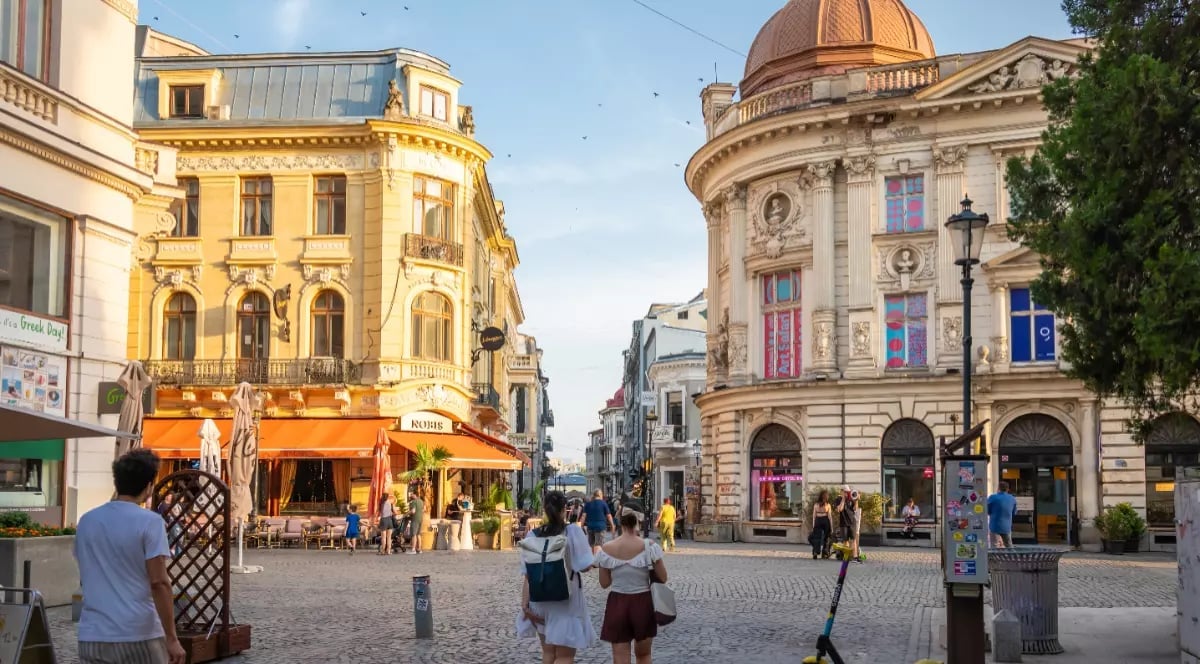
Historic yellow and cream-coloured buildings and domed architecture facing a cobblestone street in central Bucharest with pedestrians walking

Choosing where to stay in Romania looks simple.

Open a booking platform.

Filter by rating.

Compare rooms.

Look at photographs.

Read reviews.

Choose something that appears beautiful.

Done.

Except accommodation is rarely separate from the rest of the journey.

Where you stay affects:

how early you need to leave;

how late you return;

whether you walk or drive;

how often you use taxis;

how much luggage you move;

whether lunch is nearby;

whether the car becomes useful or irritating;

whether the family can return for a break;

whether the evening feels easy;

whether the next morning begins calmly.

A hotel is not only a room.

It is part of the itinerary.

And sometimes the best place to stay is not the most impressive hotel.

It is the place that makes the rest of the journey easier.

Location is part of the itinerary

Travellers often choose accommodation as though the hotel were an independent product.

Good room.

Good reviews.

Nice photographs.

Acceptable price.

But a hotel does not exist in isolation.

It exists relative to what you are doing.

A beautiful hotel can be inconvenient.

A simple hotel can be extremely useful.

A central location may save hours over several days.

A quieter location may be exactly what somebody wants.

An airport hotel can be excellent for one night and a terrible base for four days in Bucharest.

The correct question is not only:

“Is this a good hotel?”

It is:

“Is this a good hotel for this particular part of the trip?”

Those are not the same question.

Do not choose accommodation before understanding the day around it

Before looking at the room, look at the itinerary.

Where are you going tomorrow morning?

Where will you probably be in the evening?

Are you driving?

Taking a train?

Walking?

Travelling with children?

Carrying several bags?

Arriving late?

Leaving early?

Do you care about restaurants nearby?

Will you actually spend time in the hotel?

These questions often matter more than whether the lobby photographs well.

Accommodation should support the day.

Not force the day to work around the accommodation.

The best hotel can still be the wrong hotel

This is worth accepting early.

A property can be:

beautiful;

well reviewed;

comfortable;

professionally managed;

and still be the wrong choice for your journey.

Perhaps it is too far from where you will spend your time.

Perhaps parking is difficult.

Perhaps you arrive after midnight and leave early.

Perhaps you are paying for facilities you will never use.

Perhaps the room works for a couple but not for a family.

Perhaps the location is ideal without a car and inconvenient with one.

The hotel does not become bad because it is wrong for you.

Travel planning improves when we stop trying to turn every choice into a ranking.

A slightly simpler hotel in the right place can improve the entire trip

This is one of the least glamorous truths in travel.

You may remember the impressive lobby.

But you also remember:

the forty-minute journey back every night;

waiting for another car;

carrying luggage;

leaving earlier than you wanted;

driving through traffic;

looking for parking;

arriving already tired.

The simpler hotel five minutes from where you wanted to be may have created a much better trip.

Not because the room was better.

Because everything around the room was easier.

The cheapest room is not always the cheapest journey

Suppose one hotel saves you €25 per night.

Excellent.

Then you need:

two extra taxi journeys each day;

more travel time;

earlier departures;

more transport decisions.

The room is cheaper.

The journey may not be.

Price per night is easy to compare.

The cost of inconvenience is not.

That does not mean you should always pay more for location.

It means accommodation price should be understood inside the total trip.

Time has value.

Energy has value.

Transport has value.

So does being able to walk back after dinner.

The expensive hotel is not automatically the better decision either

The opposite mistake is equally common.

Spa.

Rooftop.

Beautiful restaurant.

Large room.

Excellent view.

Then the itinerary leaves at 07:00 and returns at 22:00.

You technically had access to all of it.

You mostly used the bed.

Do not pay for a hotel experience your itinerary does not leave time to experience.

If the hotel itself is part of the trip, wonderful.

Stay.

Use it.

Have breakfast slowly.

Use the terrace.

Book the spa.

Sit in the room.

But if the itinerary treats the hotel as a sleeping station, choose accordingly.

A view is expensive when you never see it

Mountain view.

City view.

River view.

Castle view.

Lovely.

But when are you in the room?

If you leave before sunrise and return after dinner, the view may become a theoretical feature.

That does not make it worthless.

It makes it worth asking whether you will actually enjoy what you are paying for.

Local DACO Note

Choose the hotel for the day you are actually going to have, not for the photograph you imagine taking there.

Travel decisions improve quickly when aspiration and actual use are allowed to meet.

One good base can be better than three exciting addresses

Moving hotels feels productive.

You are progressing.

Seeing more.

Covering more ground.

The route looks impressive on a map.

But every move contains:

packing;

checking out;

loading luggage;

driving or transferring;

waiting;

checking in;

finding the room;

rediscovering where everything is.

A hotel change is not only a new room.

It is a small relocation project.

Do it when the move improves the journey.

Not simply because another town exists.

If you cannot explain what the new hotel gives you, you may not need to move

This is one of the simplest tests.

Why are you changing accommodation?

To shorten tomorrow's road?

To experience another region?

To stay inside a place that deserves an evening and morning?

To reach a remote activity?

Good.

If the answer is:

“Because that is where the next attraction is.”

maybe.

But perhaps the existing base still works.

Local DACO Note

If you cannot explain what the new hotel gives you that the old one does not, you may not need to move.

Moving should solve something.

A beautiful route on a map can become an ugly relationship with your suitcase

Bucharest.

Sinaia.

Brasov.

Sighisoara.

Sibiu.

Every point receives its own hotel.

Visually elegant.

Operationally:

pack;

move;

unpack;

repeat.

The route may make geographical sense while producing unnecessary friction.

Our guide on How to Plan a Romania Itinerary Without Trying to See Everything looks at this problem more broadly.

Accommodation is one of the places where overplanning becomes physical.

You carry it.

Two nights are not simply twice one night

There is a qualitative difference.

The first night:

find hotel;

understand room;

find dinner;

work out neighbourhood.

The second day:

you already know where you are.

You know the street.

The café.

Where breakfast is.

How long it takes to leave.

Where the car is.

This familiarity has value.

A second night often costs money but saves cognitive effort.

That is one reason good bases work so well.

Three nights can change a city completely

On a one-night stay, a city can become:

arrive;

see;

eat;

sleep;

leave.

With more time, ordinary life appears.

You take a different street.

Return somewhere.

Notice a neighbourhood.

Have coffee without checking the departure time.

This does not mean every destination deserves three nights.

It means accommodation duration changes how you perceive the place.

Do not think only in beds.

Think in mornings and evenings too.

The morning after matters as much as the night before

Accommodation choices are often made emotionally around arrival.

Where would we like to sleep?

But the next morning may be more operationally important.

Early train?

Long road?

Airport?

Castle opening?

Mountain route?

If the answer is yes, ask whether the hotel helps tomorrow.

A beautiful room followed by an awkward departure can become less beautiful very quickly.

Hotel breakfast is logistics

Sometimes breakfast is part of the experience.

Sometimes it is simply very useful.

If you have an early road day, knowing breakfast is available at the right time can remove a decision.

If breakfast begins after you need to leave, the fact that it is excellent is irrelevant.

If you prefer cafés, perhaps hotel breakfast does not matter.

Again:

context.

The correct amenity is the one you use.

Not the one that looks impressive in the filter list.

A good breakfast can save the first forty minutes of a road day

Especially when travelling with children or several people.

Nobody needs to decide where to go.

Nobody is hungry before leaving town.

Coffee exists.

Food exists.

Then go.

This is not glamorous.

It is efficient in exactly the useful way.

But if breakfast causes a late departure you did not want, it is no longer useful.

Amenities should serve the itinerary too.

Parking can quietly decide whether you still like the hotel

A central hotel may be excellent for somebody travelling without a car.

The same hotel can become irritating for someone on a road trip.

Where do you park?

Is parking included?

Nearby?

Secure?

Restricted?

Do you need to move the vehicle?

Can you unload luggage easily?

You do not need to reject central accommodation automatically.

You simply need to understand how the car interacts with it.

A room can be perfect.

Parking can still run the relationship.

Do not rent a car and then choose accommodation as though the car does not exist

This happens.

People choose:

beautiful old centre;

pedestrian area;

historic property;

then arrive with luggage and a vehicle.

Perhaps it still works.

But check.

Our Driving in Romania guide explains the broader trade-off between the freedom of a car and the responsibility attached to it.

Accommodation is part of that responsibility.

Parking is not a philosophical concept once you are circling the block.

And do not choose a hotel for parking if you do not need a car

The opposite problem.

A hotel has easy parking.

Excellent.

But you spend four days in central Bucharest and barely use the vehicle.

Now the accommodation choice was shaped around solving a problem you did not need to have.

Transport and accommodation should be planned together.

Otherwise each begins creating problems for the other.

Bucharest: central does not mean only Old Town

This distinction matters.

Visitors sometimes search:

“Where should I stay in central Bucharest?”

and immediately assume Old Town.

It can work.

Restaurants.

Nightlife.

Walking.

Historic centre.

But Bucharest has other central areas.

Calea Victoriei and surrounding streets can provide excellent access to:

museums;

cafés;

restaurants;

major sights;

public transport;

walking routes.

Other nearby areas may offer quieter evenings while remaining practical.

The best location depends on what kind of Bucharest you want.

Our Bucharest for First-Time Visitors guide gives more context on the city itself.

Old Town is useful when Old Town is what you want

If nightlife matters.

If you want restaurants immediately outside.

If you are happy with a busier atmosphere.

Fine.

Stay there.

But choosing Old Town simply because it appears to be the centre can create a version of Bucharest that is narrower than the city.

You do not have to sleep inside every attraction you want to visit.

Walkability matters.

So does atmosphere.

Calea Victoriei can make a different kind of base

For many travellers, the wider central area around Calea Victoriei creates a useful balance.

Walking.

Architecture.

Cafés.

Museums.

Access toward several parts of central Bucharest.

It may suit people who want centrality without organising the entire stay around Old Town nightlife.

Again, this is not a hotel ranking.

It is base logic.

The street outside the hotel is part of the hotel experience too.

Quieter can still be central enough

Some travellers sleep better away from the busiest nightlife.

This becomes especially relevant for:

families;

light sleepers;

people with early departures;

longer stays.

The objective is not to be as geographically central as possible.

It is to be appropriately located for your days.

Sometimes five or ten extra minutes creates a much calmer night.

That may be an excellent trade.

An airport hotel is excellent when you actually need an airport hotel

Late arrival.

Very early departure.

Short overnight connection.

Perhaps excellent.

Four-day Bucharest city break?

Usually a very different calculation.

Do not select accommodation near the airport because it feels operationally safe if the entire trip then requires repeated travel into the city.

The airport is part of the journey.

It does not automatically need to become the base.

One airport night can make sense without defining the whole stay

Perhaps you arrive very late.

Sleep near the airport.

Move into Bucharest next morning.

Reasonable.

Or perhaps your flight home leaves extremely early.

Move closer on the final night if the benefit justifies the hotel change.

Also reasonable.

This is what good accommodation planning looks like:

using a location for the problem it actually solves.

Do not move near the airport simply because the flight is in the morning

Morning is a wide category.

A 06:00 departure and an 11:30 departure are not the same problem.

Before adding another hotel change, calculate:

departure time;

airport travel time;

check-in requirement;

transport availability;

how much the move actually saves.

Sometimes one more night in the city is still the better choice.

Brasov works well as a base because of what it connects

Brasov is worth staying in for Brasov itself.

But it is also strategically useful.

Depending on the itinerary, it can support access toward:

Bran;

Rasnov;

mountain areas;

other parts of Transylvania;

road journeys through the region.

This is why some travellers benefit from staying several nights rather than moving accommodation after every nearby attraction.

Brasov is useful as a base because of what it connects, not only because it is beautiful.

That distinction matters.

Staying in the old centre and staying outside it create different Brasov trips

If you want to walk out for:

coffee;

dinner;

old-town streets;

evening atmosphere,

central accommodation has obvious value.

If you are using the car heavily and leaving each morning for regional exploration, another location may create easier vehicle logistics.

Neither is automatically better.

The itinerary decides.

Bran does not automatically require sleeping in Bran

You may want to.

Perhaps the setting matters.

Perhaps you want an evening outside Brasov.

Perhaps accommodation itself is part of the experience.

Fine.

But visiting Bran Castle does not create an automatic accommodation requirement.

A destination and a base are different concepts.

This is one of the most useful distinctions when planning Romania.

You can visit somewhere without moving your entire trip there.

Sinaia is not simply a smaller Brasov

Sinaia has its own logic.

Peles.

Mountain setting.

Cable transport depending on current operations and weather.

A quieter rhythm.

Proximity to Bucharest compared with deeper Transylvania.

For some itineraries it works beautifully as an overnight base.

For others, it is a day stop on the way elsewhere.

Do not decide based on fame.

Decide based on route.

One night in Sinaia can be useful when it changes the road logic

Perhaps it avoids:

a rushed Peles visit;

an early departure;

an unnecessarily long day.

Then the night has a job.

That is useful.

If it creates:

pack;

move;

unpack;

leave again

without improving the journey, perhaps stay elsewhere.

Accommodation should solve road logic, not decorate it.

Sibiu often benefits from an evening

Some places change after day visitors leave.

Sibiu can be one of them.

Walking.

Restaurants.

Squares.

Evening atmosphere.

If the route allows it, staying rather than passing through can create a different relationship with the city.

That does not mean every itinerary needs a Sibiu overnight.

It means deciding whether the place is:

a stop

or

part of the stay.

Those are different roles.

Sighisoara asks a similar question

You can visit Sighisoara as part of a route.

Or stay.

The correct answer depends on:

where you came from;

where you are going;

how much time you want there;

whether the evening itself matters.

One night may be charming.

It may also create another unnecessary hotel change in an already busy itinerary.

Charm does not cancel logistics.

Maramures usually deserves more than a bed on the way somewhere else

Regions such as Maramures become weaker when treated as collection points.

Drive in.

See something.

Sleep.

Leave.

The region's value comes partly from its pace, landscapes, villages and distance from faster itineraries.

If you are going that far, give the stay enough time to justify the movement.

Our Romania by Region guide explains why some areas need to be treated as destinations rather than stops.

For Maramures specifically — which base suits which route, Breb versus Sighetu Marmației, and whether changing hotels actually reduces backtracking or just creates packing — our Maramureș Travel Guide works through the accommodation logic in detail.

Accommodation duration is part of that distinction.

Bucovina also changes the rhythm

Monasteries.

Landscape.

Roads between sites.

Rural context.

This is not the same operational journey as spending two nights in Bucharest.

Plan the base around the region's actual geography.

Sometimes the famous town name is less important than choosing a location that makes the next day's route coherent.

The correct base may not be the most recognisable name on the map.

The Danube Delta has its own accommodation logic

Water changes travel.

Boat transfer.

Departure points.

Weather.

Activity timing.

The accommodation may be more tightly connected to how the experience itself operates.

This is why the Danube Delta should not simply be added to a normal road itinerary as another hotel night.

The region changes logistics.

Treat it accordingly.

The Black Sea can be a base or a break

Constanta.

Coastal accommodation.

Beach areas.

The logic depends heavily on:

season;

purpose;

length of stay;

whether the coast is the destination or simply one part of the route.

A coastal hotel makes sense when you want the coast.

Not because Romania has one.

This sounds obvious.

Many overpacked itineraries ignore obvious things remarkably well.

Wine country is different when you do not have to drive afterwards

This is an important accommodation and transport interaction.

If wine is part of the experience, driving logic changes.

A stay in or near the area may create a slower day.

Or private transport may allow return to another base.

Our Romanian Wine — Country Escape experience is one way this can be organised.

The important point is not the product.

It is that accommodation, activity and transport should not be planned independently when alcohol is involved.

The hotel location matters differently for solo travellers

When travelling alone, a useful base can reduce:

transport decisions;

late-night navigation;

daily planning;

unnecessary journeys.

Centrality can be useful.

So can easy access to public transport.

But solo does not automatically mean city centre at any cost.

Noise.

Budget.

Personal preferences.

Arrival/departure.

All still matter.

Our guide to Romania for Solo Travellers discusses the wider logic of independence without turning everything into work.

Accommodation follows the same principle.

The hotel location matters differently for couples

Walkability may create more shared time.

A well-located base can remove repeated discussions about:

cars;

taxis;

parking;

where to eat.

A beautiful hotel may matter more if the couple intentionally wants hotel time.

Our Romania for Couples guide makes the broader point that romance is often logistical.

Accommodation is one of the clearest examples.

Sometimes the romantic decision is not the suite.

It is avoiding forty minutes of transport after dinner.

The hotel location matters differently for families

For families, returning to the hotel can be part of the day's strategy.

Rest.

Nap.

Change clothes.

Retrieve something.

Reset.

A location that makes this easy can have much more value than another property with more impressive facilities.

Our Romania with Children guide explains why the room can become part of the day's infrastructure.

Family accommodation should be evaluated as infrastructure too.

Room layout matters more than the category name

“Family room.”

“Suite.”

“Triple.”

“Apartment.”

Useful labels.

But what does the room actually contain?

How many real beds?

Which beds?

Which rooms?

Can people sleep?

Is there space for luggage?

Does the layout work for the actual travellers?

Do not assume the marketing category solves the configuration.

Look at the room.

Not only its name.

For couples, more space is not automatically more useful

A large suite can be wonderful.

If you will use it.

If the trip spends all day outside, perhaps location or comfort matters more than square metres.

Again:

pay for what supports the journey.

There is no prize for occupying the largest room while you are not inside it.

For solo travellers, the smallest room may still be the wrong room

Cheap does not automatically equal efficient.

Poor location.

No useful transport.

Difficult arrival.

No desk when you need one.

No lift with heavy luggage.

Whatever matters for your trip.

One person still has a full itinerary.

Accommodation should support it.

Stairs become more interesting when luggage arrives

Historic properties can be beautiful.

Old buildings can have:

narrow stairs;

small lifts;

no lift;

unusual access.

This may be completely fine.

Unless you have:

heavy luggage;

mobility concerns;

pushchair;

multiple bags.

A charming staircase is still a staircase.

Check before arrival if access matters.

Accessibility should be verified, not assumed

If a traveller has mobility requirements or accessibility needs, contact the accommodation and verify the specifics that matter.

Do not rely only on broad labels.

Entrance.

Lift.

Bathroom.

Room layout.

Steps.

Parking.

Distances.

The exact need determines the relevant question.

Travel planning should become more precise when accessibility matters, not more optimistic.

Check-in time is not the same as arrival time

You land at 10:00.

Room available at 15:00.

That gap exists.

Perhaps luggage storage solves it.

Perhaps early check-in is available.

Perhaps it is not.

Similarly, arriving late may require informing the property.

Simple.

But accommodation logistics begin before the room door opens.

Understand arrival.

Especially after long travel.

Luggage storage can change the usefulness of a hotel

Early arrival.

Late departure.

If storage is available, the day may remain usable.

If not, the luggage becomes the itinerary.

This is a small hotel feature with potentially large travel value.

Again, useful amenities are not always glamorous ones.

Sometimes the best facility is somewhere safe to leave the suitcase for four hours.

Late arrival changes what “good location” means

At 14:00, a ten-minute walk may be simple.

At midnight after a flight with luggage, the same movement can feel very different.

Know how you are reaching the property.

Our article What a Good Airport Transfer Should Actually Feel Like discusses arrival more broadly.

Whether using private transfer, taxi, ride-hailing or public transport, the accommodation should be easy enough to reach for the situation.

The street outside matters at night

Not necessarily because of safety.

Because of:

noise;

traffic;

bars;

restaurants;

pedestrian activity;

access;

transport.

A lively street can be exactly what you want.

Or exactly what you do not.

Look beyond the room photographs.

The neighbourhood is part of the stay.

Reviews are useful when you read them for your problem

A review says:

“Amazing location!”

For what?

Nightlife?

Train station?

Airport?

Old Town?

Restaurants?

Another:

“Too noisy.”

At what time?

Which room?

Perhaps the noise is exactly the nightlife another traveller wanted.

Reviews are evidence.

Not universal verdicts.

Read them looking for patterns relevant to your own trip.

Do not confuse rating with suitability

9.3.

Excellent.

But suitable for whom?

Couple?

Family?

Road trip?

Solo?

No car?

Car?

One night?

Five?

Rating gives information.

It does not make the decision for you.

A lower-rated property in the correct location may still create a better journey for a particular traveller.

This is why we prefer judgement to rankings.

Photos show the hotel. They rarely show your Tuesday morning.

The bed looks excellent.

Lobby beautiful.

Breakfast photograph perfect.

But Tuesday morning may involve:

checkout;

four bags;

rain;

car parked two streets away;

an early train.

This is why hotel comparison pages can never fully plan accommodation for you.

They compare properties.

You need to compare journeys.

Do not choose because someone on the internet called it “the best area”

Best for what?

A family?

Nightlife?

Museums?

Driving?

First-time visitors?

Long stays?

Quiet?

Airport?

There are useful generalisations.

There are no universal bases.

Whenever someone says best, add:

for whom?

That question improves travel planning immediately.

Walkability is valuable, but calculate the walking you will actually do

A hotel may be fifteen minutes from the centre.

Fine.

That becomes:

fifteen out;

fifteen back;

perhaps another trip later.

Over four days, this adds up.

Still perhaps completely acceptable.

But understand the cumulative movement.

Especially with:

children;

summer heat;

winter weather;

formal clothes;

late evenings.

Distance on a booking map is not experienced once.

Public transport access can be more useful than being beside one attraction

Especially in Bucharest.

A base with strong transport connections may open several areas efficiently.

The hotel beside one specific attraction may be less useful for everything else.

Think in networks.

Not landmarks.

This becomes particularly valuable when staying more than one or two nights.

Our Getting Around Romania guide covers the broader transport context.

Taxi convenience is still a cost in attention

Even when inexpensive.

Open app.

Wait.

Find car.

Ride.

Repeat.

Nothing difficult.

But every repeated transport step adds a small piece of administration.

A hotel location that removes several of those steps can make the trip feel noticeably easier.

Quiet travel often comes from removing small decisions.

A rental car makes rural accommodation more possible

This is one of the car's major advantages.

You are no longer dependent on being beside a station or central taxi network.

You can stay:

outside towns;

in countryside;

near a regional route;

somewhere chosen for setting rather than walkability.

Wonderful.

But that freedom assumes:

you are comfortable driving;

parking works;

the route works;

someone wants the responsibility.

The car expands accommodation choices.

It also changes what good accommodation means.

Rural does not automatically mean peaceful

Another travel cliché.

Countryside property.

Therefore silence.

Perhaps.

Or:

dogs;

farm activity;

church bells;

road;

events;

other guests.

Real places remain real at night.

If quiet matters greatly, check reviews and property information.

Do not buy a fantasy category.

Traditional accommodation does not automatically create a more authentic trip

This is important.

A guesthouse can be wonderful.

A modern hotel can be wonderful.

An apartment can be wonderful.

A rural pension can be wonderful.

Choose because it suits the journey.

Not because one category feels more “Romanian”.

Our What International Travellers Often Misunderstand About Romania guide discusses this wider problem with authenticity.

People do not become more genuine because their room contains more wood.

Apartment or hotel is an itinerary question too

Apartment may give:

space;

kitchen;

laundry;

privacy;

longer-stay convenience.

Hotel may give:

reception;

breakfast;

luggage storage;

cleaning;

simpler check-in;

service.

Which matters?

Depends on the trip.

A family staying five nights may answer differently from a couple staying one.

There is no superior accommodation ideology.

One-night stays favour simplicity

You arrive late.

Leave early.

You probably need:

easy access;

clean room;

reliable check-in;

comfortable sleep;

simple departure.

Perhaps this is not the night to pursue the most distinctive accommodation experience of the journey.

Every night does not need to be memorable.

Some nights should simply work.

Longer stays reward comfort differently

Five nights changes the calculation.

Storage.

Room size.

Laundry.

Neighbourhood.

Breakfast repetition.

Workspace.

Kitchen.

Access.

You begin living there slightly rather than merely sleeping there.

The right room for one night and the right room for five nights can be very different.

Do not pay for breakfast five times if you already know you want the café downstairs

This is a small example of a larger principle.

Know yourself.

If you prefer exploring cafés, perhaps breakfast inclusion has little value.

If you travel with young children and breakfast logistics matter enormously, perhaps it has great value.

Filters are not recommendations.

Amenities become valuable only in relation to the traveller.

Do not reject breakfast because “locals go to cafés”

You are not required to perform local life every morning.

Sometimes hotel breakfast is convenient.

Convenience is allowed.

You do not become less culturally engaged because you ate eggs before leaving.

Travel should not create unnecessary purity tests.

The right hotel can give the itinerary somewhere to breathe

A good base may offer:

quiet;

easy dinner;

good bed;

walkability;

a place to return in the afternoon;

a terrace;

a lobby;

a pool;

whatever matters.

That can become part of the journey's rhythm.

Accommodation is not only storage for travellers between attractions.

Sometimes it is where the day recovers.

Do not fill the recovered time automatically

You chose a central hotel.

Saved an hour.

Excellent.

You do not have to immediately add another attraction to recover the lost inefficiency.

You can use the hour for:

coffee;

rest;

walking;

nothing.

Efficiency only helps if you are allowed to keep some of what it creates.

One useful question: what does this hotel remove?

Good location removes transport.

Parking removes parking anxiety.

Breakfast removes a morning decision.

Laundry removes packing pressure.

A family room removes another room.

An airport location removes an early transfer.

A quiet location removes nightlife noise.

What problem does the property solve?

This question is often more valuable than:

“What does it have?”

Another useful question: what does this hotel create?

Distance?

Taxi dependency?

Parking problems?

A hotel change?

Early departures?

Noise?

A difficult check-in?

Facilities you feel guilty for not using?

Everything creates trade-offs.

Good planning sees both sides.

A hotel should not become a destination unless you want it to be one

Some hotels genuinely deserve time.

Spa.

Historic property.

Mountain setting.

Restaurant.

View.

That can be part of the trip.

Then plan accordingly.

But do not accidentally book a destination hotel inside an itinerary that gives it eight sleeping hours.

If the hotel matters, make room for it.

If it does not, let it simply be good accommodation.

Both are valid.

Where you stay should follow why you came

History trip.

Road trip.

Family journey.

Food.

Mountains.

City break.

Wine.

Slow travel.

Different purposes create different base logic.

This is why “best places to stay in Romania” is usually too large a question.

Romania is not one stay.

It is several different travel environments.

Our Romania by Region guide is useful here because the geography changes the accommodation decision too.

Accommodation should follow the journey. Not force the journey to follow the accommodation.

This is the same principle we use across travel services.

Perhaps you found a spectacular property.

Then realise it adds two hours to three separate days.

You now have a decision.

Maybe the hotel matters enough.

Fine.

Choose it consciously.

But do not quietly redesign the entire holiday around a room you chose because the photographs were beautiful.

The traveller remains the protagonist.

The hotel does not get promoted.

Concierge can help when accommodation becomes part of a more complicated route

Not because choosing a hotel requires Concierge.

It usually does not.

But when a journey contains:

several regions;

multiple bases;

private transport;

road logic;

different traveller needs;

early departures;

special timing,

accommodation becomes part of a larger coordination problem.

That is where DACO Concierge can help some travellers think through the itinerary as one system.

The goal is not to select the fanciest properties.

It is to make the locations work together.

We do not need to book every room to help you understand where to stay

This matters.

Travel advice should remain useful even when no service is purchased.

Perhaps you book every property yourself.

Excellent.

If this guide helps you choose better bases, it has done its job.

Local knowledge should improve decisions.

Not create dependency.

The best accommodation advice sometimes tells you not to change accommodation

Stay another night.

Drive out and return.

Skip the extra check-in.

Keep the same base.

That advice does not create more hotel bookings.

It may create a better journey.

We prefer that.

Sometimes the right answer is the boring hotel

Near airport.

Easy parking.

Reliable check-in.

Comfortable bed.

Breakfast at the right time.

Nothing remarkable.

Perfect.

Not every accommodation choice needs personality.

There are moments when reliability is the personality.

Sometimes the right answer is the hotel you remember for years

Also true.

A room.

View.

Building.

Breakfast.

Setting.

Staff.

Something becomes part of the trip.

Wonderful.

Travel planning is not about removing beauty in the name of efficiency.

It is about giving beauty enough time to matter.

Choose the memorable place when the journey can actually receive it.

Where you wake up changes the day

This may be the simplest way to think about accommodation.

Wake up inside the city.

Wake up near the road.

Wake up in the mountains.

Wake up near the airport.

Wake up beside the old centre.

Each morning begins differently.

That is why accommodation is not an afterthought.

It is the first location of every travel day.

Common questions

Frequently Asked Questions

If we could give you one accommodation rule

Do not choose the room first.

Choose the journey.

Then ask what kind of base helps that journey work.

Where do you need to wake up?

Where will you return at night?

Will you walk?

Drive?

Take the train?

Will you actually use the hotel?

Does changing accommodation improve the route?

Or only make the map look more complete?

Choose the view if you will sit and look at it.

Choose the breakfast if it makes the morning easier.

Choose centrality if it gives you back useful time.

Choose parking if the car genuinely matters.

Choose the beautiful hotel when the itinerary leaves room for beauty.

Choose the boring hotel when reliability is exactly what the night requires.

Stay another night when another check-in solves nothing.

And remember:

Where you sleep is not separate from how you travel.

It shapes the morning.

The evening.

The walk.

The drive.

The meal.

The amount of luggage you move.

The amount of time you lose.

The amount of energy you keep.

Choose the hotel that supports the journey.

Not the hotel that wins the comparison page.

The right base should make the trip feel quieter.

DACO Team

Local travel knowledge from DACO Private Travel, Bucharest.

Romania, Privately Arranged.

Not sure which bases make sense for your route?

Tell us where you want to go, how you plan to move and what matters most about the journey. We can help you think through the route and overnight logic so each stay supports the trip instead of adding another layer of logistics.

Plan My Trip