
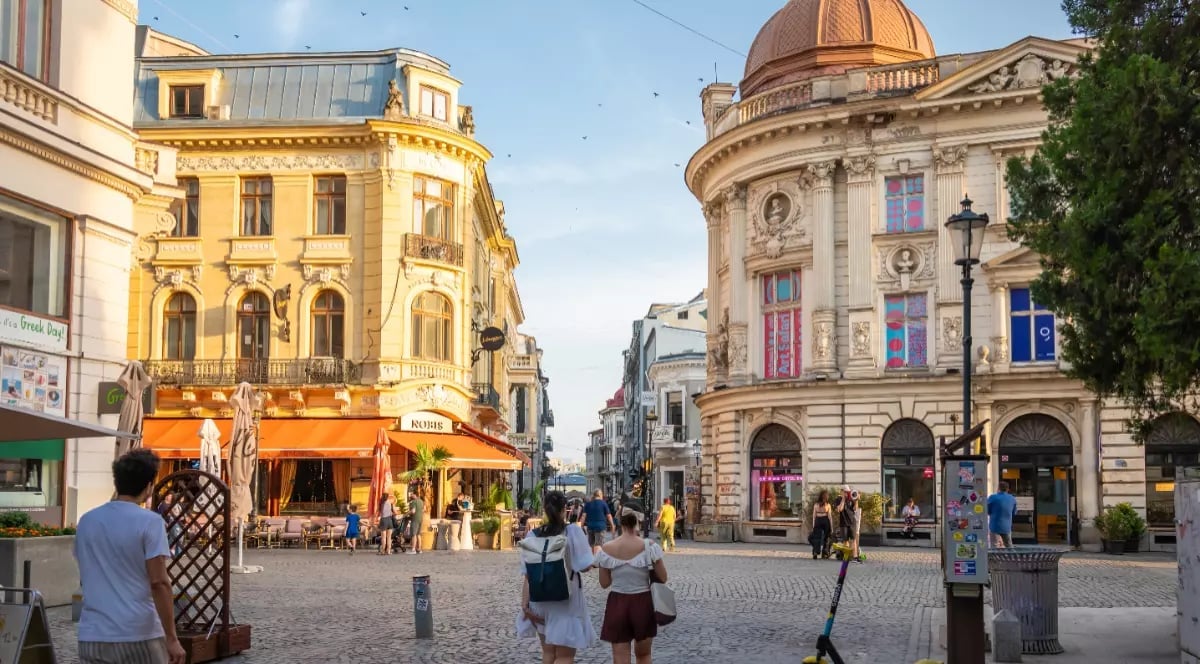
Bucharest does not always reveal itself immediately.
For many first-time visitors, the first impression is a mixture of grand buildings, busy boulevards, quiet residential streets, old houses, glass offices, cafés and architecture from several completely different periods standing almost side by side.
It can feel difficult to place.
And that is part of what makes the city interesting.
Bucharest is not a perfectly preserved historic capital. It has been repeatedly changed by politics, earthquakes, demolition, reconstruction and the everyday decisions of the people who live here.
The result is a city with visible layers.
You may turn a corner from a monumental boulevard and find a small interwar villa beneath old trees. A few streets later, you are looking at communist-era architecture. Then comes a neighbourhood café, an Orthodox church or a building that seems to belong to another European capital entirely.
For a first visit, our advice is simple:
Do not try to understand Bucharest only through its landmarks.
Give the city enough time to show you what exists between them.
How many days do you need in Bucharest?
For most first-time visitors, two days is a very good starting point.
One full day can give you a useful introduction to the main areas and landmarks.
Two days allows you to slow down enough to understand the city better.
Three days becomes particularly worthwhile if you enjoy museums, architecture, food, neighbourhoods or simply having time without a strict itinerary.
If Bucharest is only the beginning of a longer Romanian journey, two nights often work naturally before continuing towards places such as Sinaia, Brasov or Transylvania.
When you have a single free day, our guide to the best day trips from Bucharest is a practical place to compare the main options without overcommitting your itinerary.
The important thing is not to fill every hour.
Bucharest benefits from some unplanned time.
Start by understanding the centre
Most first visits naturally begin around central Bucharest.
This makes sense.
Many important landmarks, historic streets and restaurants are concentrated here, and much of the city can be understood by walking between them.
A first route might connect areas around:
- Calea Victoriei;
- Revolution Square;
- the Romanian Athenaeum;
- University Square;
- the Old Town;
- the Palace of Parliament;
- and the quieter streets that sit between the major boulevards.
But we would resist turning this into a checklist.
The value is often in the walk itself.
Calea Victoriei, for example, is not interesting because of a single attraction. It works because several periods of Bucharest appear along the same street.
Walk slowly enough and the city begins to explain itself.
The Old Town is part of Bucharest, not all of Bucharest
Many visitors encounter the Old Town first.
It is central, compact and filled with restaurants, bars and historic buildings.
It is worth seeing.
But it should not become your entire impression of the city.
The Old Town is one of the most tourism-oriented areas of Bucharest, particularly in the evening.
A few streets away, the atmosphere can change completely.
For us, this contrast is important.
If you only experience Lipscani and the streets immediately around it, you may leave knowing where Bucharest goes out at night but not necessarily what the city feels like.
Use the Old Town as one chapter.
Not the whole story.