
Romania Travel Knowledge Hub

Bucharest Old Town Guide: What to See, Do and Know Before You Go

By Neli Budeanu

Co-founder, DACO Private Travel · Former hospitality professional in Bucharest

Local travel knowledge based on living in Bucharest, working in hospitality and helping organise journeys for international visitors.

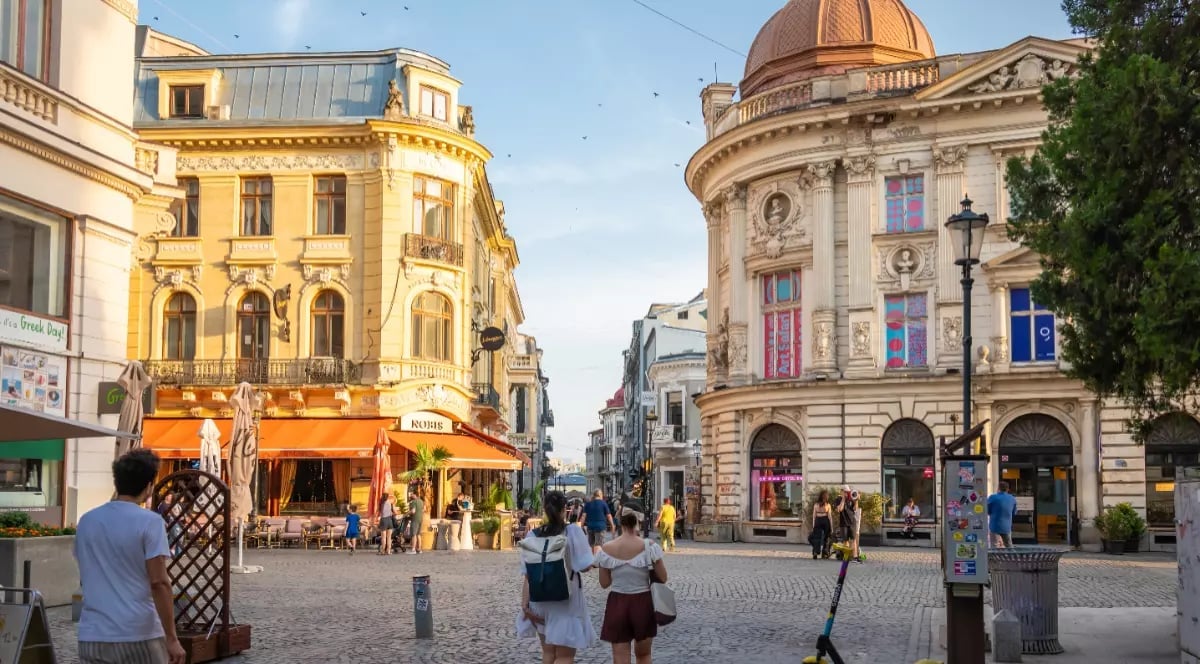
Bucharest Old Town historic street with yellow and cream-coloured European buildings, domed architecture and pedestrians at the heart of the historic centre

Bucharest Old Town is worth visiting.

But it is worth visiting for a few different reasons — and not necessarily for an entire day.

During the morning, you can walk through historic streets, enter small churches, notice old banks and inns and begin to understand where commercial Bucharest developed.

By evening, terraces fill.

Later at night, some streets become almost entirely about bars, music and nightlife.

All three versions are real.

The mistake is assuming that any one of them represents Bucharest as a whole.

For most first-time visitors, I would spend a few hours exploring the Old Town properly, then continue into Calea Victoriei, Revolution Square or another part of central Bucharest.

Visit it.

Just do not stop there.

Bucharest Old Town at a Glance

Question Local answer
Is it worth visiting? Yes
How long do you need? Around 2–4 hours for sightseeing
Best time for architecture? Morning or daytime
Best time for atmosphere? Late afternoon and evening
Good for nightlife? Very
Good place to stay? For some travellers, not automatically
Walkable? Extremely
Is it safe? Generally easy to visit with normal city precautions
Best for History, walking, architecture, restaurants and nightlife
Enough to understand Bucharest? No — explore beyond it

What Is Bucharest Old Town?

Bucharest Old Town is the compact historic and commercial centre around streets such as Lipscani, Stavropoleos, Franceză, Șelari and Smârdan.

You may also hear it called:

Old Town.

Centrul Vechi.

Lipscani.

These names are often used almost interchangeably by visitors, although Lipscani is technically one street — and historically one of the most important commercial streets within the wider area.

The district sits between several important central parts of Bucharest, with University Square to the north, Piața Unirii to the south and Calea Victoriei immediately to the west.

That location makes it exceptionally easy to include in a first visit.

You do not need transport once you are inside it.

You walk.

And because the area is compact, you can see a meaningful amount without turning it into an entire-day project.

Is Lipscani the Same as Bucharest Old Town?

In everyday tourism language, almost.

But not exactly.

Lipscani is a street and the name historically became strongly associated with the surrounding commercial district.

The name is connected to merchants trading goods brought from Leipzig — Lipsca in older Romanian usage.

The wider Old Town contains many more streets, buildings, churches and historical layers.

This matters because searching only for “Lipscani Street” on a map can give you the impression that the attraction is one particular road.

It is not.

The better experience is the network of streets around it.

Is Bucharest Old Town Really Old?

Yes — but not in the way the phrase “Old Town” can sometimes imply.

Do not expect a perfectly preserved medieval quarter where every building comes from the same historical period.

Bucharest did not develop that way.

This area contains traces of the city's old commercial and princely centre, but what you see today comes from different centuries.

There are churches.

Former inns.

Banks.

Commercial buildings.

Passages.

Nineteenth- and twentieth-century architecture.

Restored façades.

Buildings still waiting for restoration.

Modern restaurants operating inside historical spaces.

That mixture is actually more representative of Bucharest than a perfectly preserved historic district would be.

The city has repeatedly changed.

The Old Town changed with it.

What Should You See in Bucharest Old Town?

You do not need to hunt for twenty attractions.

A good walk through the area can naturally connect:

  • Stavropoleos Church;
  • CEC Palace;
  • the National Bank area;
  • Lipscani Street;
  • Macca-Villacrosse Passage;
  • the Curtea Veche area;
  • Saint Anton Church;
  • Manuc's Inn;
  • and the smaller streets between them.

The point is not simply to collect each name.

Walk slowly enough to notice how different they are.

That contrast tells you much more about Bucharest than a checklist.

Start Around CEC Palace and the Western Edge of the Old Town

One of the easiest ways to enter the Old Town is from Calea Victoriei.

CEC Palace sits immediately beside the historic district and creates one of central Bucharest's most recognisable architectural transitions.

On one side you have Calea Victoriei.

On the other, the smaller scale of the Old Town begins.

This is a useful starting point because it also prevents the Old Town from becoming an isolated destination.

It belongs to central Bucharest.

Within minutes you can move between monumental architecture, former commercial streets, churches and contemporary cafés.

That proximity is one of the area's strengths.

Walk Lipscani — But Explore the Side Streets Too

Lipscani is the name almost everybody knows.

Walk it.

Then turn away from it.

Some of the more interesting moments in Bucharest Old Town happen on the streets connecting the major landmarks rather than directly in front of them.

Look upward.

Ground floors are dominated by restaurants, shops and signs.

The upper floors often tell another story.

Old architectural details remain.

Some buildings are beautifully restored.

Others show exactly how uneven Bucharest's relationship with its architectural heritage can still be.

That imperfection is part of the city.

Do not expect every corner to be polished.

Step Into Stavropoleos

Stavropoleos is one of the places I would genuinely not skip.

The church was founded in the eighteenth century and is remarkably small compared with the visual attention it commands.

Its stone carving, painted details, courtyard and scale create a dramatic contrast with the commercial streets surrounding it.

A few metres away there may be restaurant terraces and groups moving through the Old Town.

Inside, you are entering an active Orthodox religious space.

Treat it accordingly.

This is not simply another tourist attraction.

Services, prayer and monastic life continue here.

Dress and behave respectfully, avoid disrupting worship and check the official Stavropoleos visitor information if you need current access details.

You do not need an hour.

Sometimes fifteen quiet minutes are more valuable.

Walk Through Macca-Villacrosse Passage

Macca-Villacrosse Passage is one of those places that works well as part of a walk but does not need to become an itinerary by itself.

The covered passage connects streets near Calea Victoriei and the historic centre.

Its architecture and curved glass-covered galleries give you another glimpse of the commercial Bucharest that developed beyond the much older princely core.

Today it is also filled with hospitality venues.

Walk through.

Look up.

Continue.

Not every interesting place needs an hour.

See the National Bank Area

The historic headquarters of the National Bank of Romania immediately changes the architectural character of the district.

That matters.

Bucharest Old Town was not simply a collection of inns and churches.

This was a commercial centre.

Money moved here.

Merchants worked here.

Banks developed here.

Businesses operated here.

Understanding that makes Lipscani more interesting.

The district was part of the economic city long before it became one of Bucharest's main nightlife areas.

What About Curtea Veche and Vlad the Impaler?

This is where tourist storytelling can become too convenient.

Curtea Veche — the Old Princely Court — is one of the most historically important places in central Bucharest.

The princely court represents the early political centre around which the city developed.

Vlad III, commonly known internationally as Vlad the Impaler, is part of the history connecting Bucharest with the rulers of Wallachia.

But this does not make Bucharest Old Town a Dracula theme park.

Nor should every historical fragment be turned into a vampire story.

There is a more interesting real history here.

The archaeological site of the Palatul Voievodal Curtea Veche has undergone a major rehabilitation project and interior public access has been closed during the works.

Check the official Curtea Veche information from the Bucharest Municipality Museum for current access before planning a visit.

Even while interior access is unavailable, understanding why the princely court existed here helps explain the development of the surrounding district.

See Saint Anton Church

Beside the Curtea Veche area stands Saint Anton Church, historically connected to the old princely court.

It is easy to pass quickly because the surrounding area attracts so much visual attention.

Again, slow down.

The churches inside and around Bucharest Old Town are useful because they remind you that this district existed long before bars, restaurant terraces and weekend tourism.

The nightlife is the newest layer.

Not the original identity.

Stop at Manuc's Inn — But Understand Why It Matters

Manuc's Inn sits near the southern edge of the Old Town, close to Piața Unirii.

Even without turning it into a restaurant recommendation, the building is worth understanding.

Historic inns were part of how commercial cities functioned.

Travellers arrived.

Merchants traded.

People ate.

Goods moved.

Information moved with them.

That makes an inn far more interesting than simply saying it is “old”.

If you stop for food or a drink, fine.

If you simply walk through and continue your route, that also makes sense.

The building is part of the story of the district.

You are not required to turn every historic venue into a meal.

How Long Do You Need in Bucharest Old Town?

For most first-time visitors:

two to four hours is enough for a meaningful daytime visit.

That gives you time to walk rather than rush, enter Stavropoleos, explore several streets and stop for coffee or food.

You may need longer if you deliberately add:

  • a long lunch;
  • museum visits;
  • extensive photography;
  • shopping;
  • dinner;
  • nightlife.

But I would not automatically reserve an entire sightseeing day for Old Town.

Bucharest has too much happening outside it.

If this is your first visit, combine the district naturally with Calea Victoriei, University Square or another central area.

Our Bucharest in One Day and Bucharest in Two Days guides show how to do that without crossing the city unnecessarily.

Is Bucharest Old Town Better During the Day or at Night?

They are almost two different experiences.

During the morning

This is when I prefer it for architecture and history.

The streets are quieter.

You can actually look at buildings.

Church visits feel less rushed.

Photographs are easier.

You notice things that disappear once the terraces fill.

During the afternoon

The district becomes more active.

Restaurants fill.

More visitors arrive.

It remains easy to explore.

During the evening

This is when Old Town becomes one of Bucharest's main social areas.

Terraces, restaurants and bars dominate many streets.

For dinner and people-watching, that energy can be enjoyable.

Late at night

Parts of the district become primarily nightlife territory.

Music.

Bars.

Clubs.

Groups moving between venues.

That may be exactly what you want.

Or exactly what you do not want.

Neither reaction is wrong.

Choose your timing according to what you actually want from the place.

Is Bucharest Old Town Safe?

For most visitors, Bucharest Old Town is a straightforward central area to explore.

It is heavily used by locals and tourists and remains active late into the evening.

Normal city awareness still matters.

In crowded nightlife environments:

  • keep an eye on your phone and belongings;
  • know what you are ordering and what it costs;
  • do not accept services or offers you do not understand;
  • use clearly identified transport or an established ride-hailing service when leaving;
  • and remember that very crowded areas plus alcohol naturally reduce awareness.

This is not advice specific to some unusually dangerous neighbourhood.

It is simply sensible behaviour in a busy entertainment district.

During the day, most visitors will experience Old Town as an easy pedestrian part of central Bucharest.

Is Old Town Just for Tourists?

No.

But it is one of Bucharest's most tourism-oriented areas.

Both statements can be true.

Romanians eat, drink and meet here.

Offices and businesses exist nearby.

Religious spaces remain active.

Historic institutions operate around the district.

But a significant part of the restaurant, bar and entertainment economy is clearly designed around visitors and nightlife.

If you want to understand everyday residential Bucharest, this is not where I would stop.

Go north.

Walk around other central neighbourhoods.

See Calea Victoriei.

Sit somewhere where nobody is trying to sell you a Bucharest experience.

The contrast will improve your understanding of the city.

Where Should You Eat in Bucharest Old Town?

I would not choose a restaurant simply because it occupies the busiest terrace.

And I would not give you a permanent “10 best restaurants” list and pretend it will remain accurate forever.

Restaurants change.

Chefs change.

Management changes.

Menus change.

What I would do instead is walk first.

Look at several options.

Read the menu before sitting down.

Decide what you actually want to eat.

If you want Romanian food, choose somewhere where Romanian cooking is genuinely the point rather than one section inside an enormous international menu.

If someone is aggressively trying to bring you inside, remember that you have many other choices a few metres away.

And if food is a major reason for your trip, do not restrict yourself to Old Town.

Contemporary Bucharest has excellent restaurant areas outside the historic centre.

Our Romanian Food Explained guide is the better place to explore that subject in depth.

Should You Stay in Bucharest Old Town?

Sometimes.

Not automatically.

Old Town is an excellent accommodation choice if you want:

  • nightlife outside the door;
  • restaurants within a few minutes;
  • a very short stay;
  • easy walking access to the historic centre;
  • to return to your accommodation late without crossing the city.

I would consider somewhere else if you:

  • sleep lightly;
  • are travelling with young children;
  • prefer quiet evenings;
  • are staying several days;
  • want a more residential atmosphere;
  • want your immediate surroundings to represent more than nightlife and tourism.

The exact street matters enormously.

A room on a quieter edge of the Old Town can be a completely different experience from accommodation directly above one of its late-night streets.

Do not book based only on the words “Old Town”.

Check the map.

Check recent guest comments about noise.

Our Best Areas to Stay in Bucharest guide compares Old Town with Calea Victoriei, Piața Romană and other useful bases.

Is Old Town Good for Families?

During the daytime, absolutely.

It is compact.

You can walk.

There are places to stop.

Distances between sights are short.

With children, I would simply favour morning or daytime rather than making the nightlife version of the district the centre of the experience.

For accommodation, I would be more selective.

A family wanting reliable sleep may be better just outside Old Town while remaining within walking distance.

Is Bucharest Old Town Good for Solo Travellers?

It can be particularly easy for solo travellers because you do not need to organise much.

Walk out of the metro or your hotel.

Choose a street.

Stop when you want.

Eat when you want.

Continue toward Calea Victoriei or University Square without arranging transport.

The same normal precautions apply as in any crowded nightlife area, particularly later in the evening.

But logistically, it is one of the easiest areas of Bucharest to explore alone.

What Should You Avoid in Bucharest Old Town?

Mostly, bad decisions rather than particular streets.

  • Do not spend your entire Bucharest visit there.
  • Do not assume the restaurant with the most visible terrace is automatically the best.
  • Do not mistake nightlife for local culture as a whole.
  • Do not walk through Stavropoleos as though it were simply another entertainment venue.
  • Do not build your visit around an interior Curtea Veche tour without checking whether the archaeological site has reopened.
  • Do not book a hotel on a nightlife street and then be surprised that nightlife makes noise.
  • And do not try to complete the district like a checklist.

It is compact enough that wandering is part of the experience.

What Is Near Bucharest Old Town?

This is one of the strongest reasons to include the district.

You are already in the middle of central Bucharest.

From the Old Town you can continue naturally toward:

  • Calea Victoriei for architecture, museums and a broader introduction to the city.
  • University Square for another important part of central Bucharest.
  • Revolution Square and the Romanian Athenaeum, farther north along the central route.
  • Piața Unirii immediately south.
  • The Palace of Parliament area, farther west.

This means you rarely need to treat Old Town as a separate excursion.

It should simply become one section of a well-planned city walk.

Can You Explore Bucharest Old Town Independently?

Very easily.

You absolutely do not need a guide to find Lipscani Street or Stavropoleos.

The area is compact enough to explore on foot and difficult to get seriously lost in.

Where a local guide adds value is interpretation.

  • Why did the commercial city develop here?
  • Why is Lipscani called Lipscani?
  • What role did the princely court play?
  • Why do an eighteenth-century church, nineteenth-century banks, former inns and contemporary bars exist almost beside one another?
  • What survived?
  • What disappeared?
  • How does this small district connect with the much larger history of Bucharest?

Those are different questions from:

“Where do we turn next?”

Our Bucharest Highlights Tour uses places such as these as part of the wider story of the city rather than treating the Old Town as an isolated attraction.

What Would I Personally Do on a First Visit?

I would come in the morning.

Enter from the Calea Victoriei side.

Walk through the smaller streets before they become busy.

Visit Stavropoleos.

Pass the historical banking district.

Continue toward Curtea Veche and Saint Anton.

Reach Manuc's Inn.

Then I would leave the Old Town.

Not because there is nothing else to see.

Because there is.

Bucharest starts becoming more interesting when you compare this district with the rest of the city.

Later, if I wanted dinner or nightlife, I could return.

That gives you two different experiences without spending an entire day inside the same few streets.

The Local View

Bucharest Old Town is worth your time.

It contains some of the most important traces of the city's historical centre and remains one of the easiest areas for a visitor to explore.

But its current identity is a mixture:

history;

religion;

commerce;

tourism;

restaurants;

nightlife.

Do not demand that it be only one of those things.

And do not ask it to represent all of Bucharest.

Come for the history in the morning.

Stay for lunch if you like.

Return after dark if nightlife interests you.

Then walk beyond it.

That is where Bucharest becomes much more complicated — and much more interesting.

Common questions

Frequently Asked Questions

Continue Exploring Bucharest

If you want the complete first-time overview, continue with the Bucharest Travel Guide.

If you are deciding what is genuinely worth prioritising across the entire city, read Is Bucharest Worth Visiting?

If you have one day, use Bucharest in One Day. If you have two days, continue with Bucharest in Two Days.

If you are deciding whether sleeping inside the historic centre is right for you, read Best Areas to Stay in Bucharest.

And if you would rather understand how the Old Town fits into the wider history of the capital with someone local, explore the Bucharest Highlights Tour.

Romania, privately arranged.

Neli Budeanu

Co-founder, DACO Private Travel · Former hospitality professional in Bucharest

Local travel knowledge based on living in Bucharest, working in hospitality and helping organise journeys for international visitors.