Romania Travel Knowledge Hub
By Neli Budeanu
Co-founder, DACO Private Travel · Former hospitality professional in Bucharest
Local travel knowledge based on living in Romania, working in hospitality and helping organise journeys for international visitors.
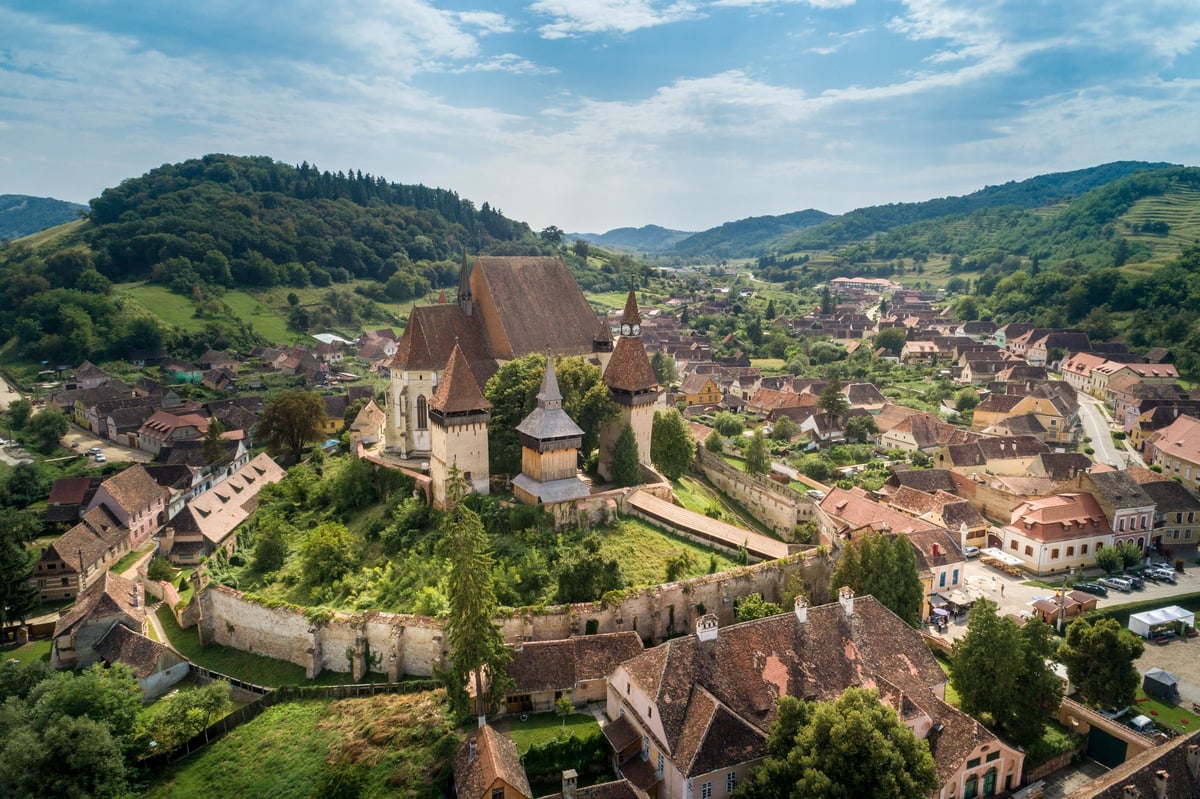
There is a dangerous moment in planning a Transylvania trip.
You discover the fortified churches.
Then you discover UNESCO recognises seven villages.
And suddenly a perfectly good journey has become a collection exercise.
Biertan.
Prejmer.
Viscri.
Dârjiu.
Saschiz.
Câlnic.
Valea Viilor.
Seven names.
Seven pins.
Seven things to complete.
Please do not do that.
The point of these places is not that there are seven of them.
It is that they preserve different parts of a cultural landscape shaped by villages, churches, fortifications, agriculture, religion, community organisation and centuries of change.
For most first-time visitors, one or two well-chosen fortified villages are enough.
Choose them because they fit your route.
Not because UNESCO gave you homework.
If you are staying in Brașov, start with Prejmer.
If you want the strongest combination of village, countryside and fortified church, consider Viscri.
If you are travelling from Sighișoara toward Sibiu, Biertan fits extremely well.
If you are already travelling near Sighișoara, Saschiz can be a logical addition.
If you want to explore deeper into the heritage landscape, Valea Viilor, Dârjiu and Câlnic become much more interesting.
That does not make the last three less important.
It makes geography important.
| Place | Best for | Route logic |
|---|---|---|
| Prejmer | First fortified-church experience, defensive architecture | Easy from Brașov |
| Viscri | Village landscape, rural heritage, slow travel | Brașov–Sighișoara area |
| Biertan | Architecture, fortified complex, history | Excellent between Sighișoara and Sibiu |
| Saschiz | Convenient UNESCO stop in the Târnava landscape | Near Sighișoara |
| Valea Viilor | Strong fortified architecture, quieter rural route | Mediaș / Sibiu County |
| Dârjiu | Székely and Unitarian heritage | Deeper regional route |
| Câlnic | Different type of fortified complex | Western/southern Transylvania route |
The UNESCO World Heritage property is officially called:
Villages with Fortified Churches in Transylvania.
The story began in 1993, when Biertan and its fortified church were inscribed.
In 1999, the property was extended to create the current serial World Heritage site of seven components.
Those seven are:
Biertan.
Prejmer.
Viscri.
Dârjiu.
Saschiz.
Câlnic.
Valea Viilor.
That list matters because other famous fortified churches in Transylvania are often accidentally described as part of the same UNESCO property.
They are not.
Hărman is not one of the seven.
Sânpetru is not one of the seven.
Cisnădioara is not one of the seven.
Mălâncrav is not one of the seven.
They may still be culturally important and worth visiting.
UNESCO simply means something more specific.
Not seven isolated church buildings.
That is one of the most important things to understand.
UNESCO describes a wider cultural landscape.
Village structure.
Land use.
Farmsteads.
Community organisation.
Fortifications.
Religious buildings.
The relationship between settlement and surrounding agricultural land.
In other words:
the church matters.
But so does the village around it.
If you drive into Viscri, photograph the fortified church, return to the car and leave fifteen minutes later, you have technically seen the monument. You have not really understood the World Heritage idea.
No.
And this distinction matters.
Much of the fortified-church landscape of southern Transylvania is strongly associated with the Transylvanian Saxons, the German-speaking communities whose settlement history shaped many towns and villages across the region.
But reducing all seven UNESCO sites to “Saxon villages” is too simple.
Dârjiu is the important exception.
Its fortified church belongs to a Hungarian/Székely and Unitarian cultural context.
Romania's National Heritage Institute explains that the fortified-church model used in Saxon settlements was also adopted by neighbouring Székely communities, with Dârjiu being an important example.
That makes the UNESCO group more interesting.
Not less coherent.
Heritage rarely respects the clean labels travel marketing gives it.
Because the church was already one of the central structures of the community.
When defence became necessary, communities developed systems around or within it.
Walls.
Towers.
Bastions.
Defensive levels.
Storage rooms.
Refuge spaces.
Different sites developed different solutions.
At some fortified complexes, community infrastructure allowed basic life to continue during periods of danger.
Food could be stored.
People could shelter.
The fortified church therefore becomes easier to understand when you stop seeing it only as religious architecture.
It was also community infrastructure.
If someone staying in Brașov asks me:
“I only want to see one fortified church. Which one?”
Prejmer is one of the easiest answers.
Not because it is objectively the best.
Because it makes sense.
The route from Brașov is manageable.
The defensive structure is easy to understand.
And you do not need to reorganise an entire Transylvania journey around it.
The National Heritage Institute identifies Prejmer as a particularly strong example of the fortified-enclosure type, where much of the defensive system is concentrated around the church rather than transforming the church building itself into the entire fortress.
Walk inside the enclosure and the defensive logic becomes obvious.
Walls.
Internal spaces.
Protection.
Storage.
Community organisation.
This is one of those places where architecture explains history more efficiently than a paragraph can.
Access and opening arrangements can change seasonally. Local church and heritage administrators confirm current visitor arrangements; this guide deliberately does not list fixed hours or admission prices.
Yes.
Particularly if:
you are based in Brașov;
you have limited time;
you want to understand the fortified-church concept;
you are not travelling deeply through rural Transylvania later.
If your route already contains several fortified villages further west?
Then Prejmer becomes optional.
That is not criticism.
It is itinerary editing.
For many travellers, yes.
But not because Viscri is “untouched”.
It is not.
Viscri is now one of Romania's best-known villages internationally.
Visitors arrive.
Guesthouses operate.
Local products are sold.
Cars arrive.
Heritage tourism exists.
And people still live there.
All of those facts can coexist.
The real strength of Viscri is the relationship between:
the fortified church;
the village street;
traditional houses;
farm plots;
the surrounding hills;
and a settlement structure that becomes much easier to understand when you walk rather than simply visit the church.
Local visitor access and parking arrangements around the village are organised and can change. Please follow current on-site directions and respect residential life; this guide deliberately does not hard-code seasonal hours.
That depends what you expected.
If you expected to discover a secret Saxon village nobody had heard of, yes, reality will interfere.
But popularity does not erase heritage.
The better question is:
Can you visit respectfully and still understand why the place matters?
Yes.
Park where current local arrangements direct visitors.
Walk.
Notice the houses.
Do not enter private courtyards because the gate looks beautiful.
Do not photograph residents as if they are heritage exhibits.
Visit the fortified church.
Then spend enough time outside it that you understand it belongs to a village.
No.
But you can.
A rural overnight stay makes sense when the countryside itself is part of the trip.
Dinner.
Evening.
Morning.
Walking.
Slower rhythm.
If tomorrow's route then requires two hours of backtracking merely because the guesthouse looked lovely online?
Maybe not.
Rural accommodation should serve the journey. Not defeat it.
This is one of my favourite examples of route logic.
Imagine you are already travelling:
Sighișoara → Sibiu.
Biertan suddenly makes much more sense than it does as a separate expedition from Brașov.
The church rises above the village.
Multiple defensive enclosures reinforce the sense that this was more than a decorative religious building.
And Biertan has another layer of importance in Transylvanian Saxon religious history.
For centuries, it held an important role within the Evangelical church organisation of the region.
It was also the original World Heritage inscription before UNESCO expanded the property to the seven sites we know today.
Yes.
Particularly if:
you are travelling between Sighișoara and Sibiu;
you care about architecture;
you want a major fortified complex;
you are interested in Saxon religious history.
If you already spent several hours in Viscri yesterday and are tired of fortified churches?
Skip it.
The fact that something is important does not mean your itinerary must contain it.
This is a much better question than:
“Which is better?”
Choose Viscri if you want:
the village landscape;
more time walking through a rural settlement;
the relationship between church, houses and countryside;
a stop that fits naturally around the Brașov–Sighișoara corridor.
Choose Biertan if you want:
a strong fortified-church complex;
architectural drama;
religious history;
a stop that fits naturally between Sighișoara and Sibiu.
If you have enough time, both can work.
If you do not? Choose according to direction.
Saschiz receives less international attention than Viscri.
That does not make it a hidden gem.
It makes it another part of the same cultural landscape.
Its biggest practical advantage is geography.
If your journey already runs through the area around Sighișoara, Saschiz can fit without turning the itinerary into an expedition.
The National Heritage Institute identifies the fortified church at Saschiz as an important example of a later defensive type in which the church itself became strongly equipped for defence.
That architectural distinction matters more after you have already seen another type of fortified church.
One site introduces the idea.
The second shows variation.
That is a much stronger reason to visit than collecting another UNESCO pin.
Valea Viilor is less likely to appear on a first traveller's shortlist.
That is not a problem.
Not every heritage site needs to become famous internationally.
The fortified church is important because of the complexity of its defensive architecture.
The National Heritage Institute specifically identifies Valea Viilor among the strong examples of the fortified-church type in the hilly areas of Transylvania.
For travellers moving around Mediaș, Biertan and Sibiu County, it can fit very naturally.
For somebody staying two nights in Brașov?
Probably not.
Again:
geography before fame.
Dârjiu may be the most useful site for correcting an oversimplified understanding of fortified churches.
Because Dârjiu is not simply another Saxon Evangelical village.
The fortified church is Unitarian.
The cultural context is Hungarian/Székely.
The National Heritage Institute explains that the defensive model developed in Saxon settlements influenced neighbouring Székely communities.
Dârjiu is an important example of that exchange.
The church itself contains medieval heritage, including historic mural painting, while the fortified enclosure reflects the defensive role of the complex.
If your interest is deeper cultural history rather than the most convenient first route?
Dârjiu becomes extremely interesting.
It demonstrates something essential about Transylvania:
cultures were not sealed into separate boxes.
Ideas moved.
Architecture moved.
Defensive solutions moved.
Communities remained distinct while influencing one another.
That is considerably more interesting than pretending every fortified church tells the same story.
Câlnic deserves careful explanation because its history does not fit the simple mental picture:
village builds church → church becomes fortress.
The major fortified complex at Câlnic originated as a medieval noble residence.
A fortified dwelling.
A defensive enclosure.
Later, after it passed into the hands of the Saxon community, the complex was expanded and adapted for communal defensive and religious use.
A chapel became part of the fortified ensemble.
That makes Câlnic valuable precisely because it is different.
If you visit several UNESCO components, differences are what stop the journey becoming repetitive.
If you are based in Brașov and have limited time:
Prejmer is easier.
You get a clear fortified-church experience without dedicating most of a day to rural routing.
Choose Viscri when:
the village matters as much as the church;
you want countryside;
you have more time;
your route already heads toward Sighișoara.
This is not about which Instagram photograph looks better.
It is about what experience you actually want.
Again:
look at the map.
From Brașov?
Prejmer.
Between Sighișoara and Sibiu?
Biertan.
The internet loves rankings because rankings are easy.
Roads prefer geography.
No.
I would actively advise most first-time travellers not to.
After the third or fourth fortified church in a rushed day, something unfortunate happens.
Details disappear.
One wall becomes another wall.
One tower becomes another tower.
You start asking:
“Which one was this?”
That is not heritage travel.
That is visual saturation.
One excellent experience is better than four blurred ones.
Two can work beautifully when they belong to the same geographical route.
For example:
a rural route around Sighișoara;
or a Biertan/Valea Viilor journey depending on where you begin and end.
Three may work for somebody with a specific architectural interest.
But I would not build a normal first-time Transylvania day around maximum church count.
You are travelling through villages.
There should be time to actually see them.
Usually, a car or private transport makes rural fortified-church travel considerably easier.
This is one of the clearest differences between city travel and rural Transylvania.
Brașov.
Sighișoara.
Sibiu.
These can work with rail.
The villages do not line themselves up conveniently around train stations simply because your itinerary would benefit.
Road transport gives you:
route flexibility;
multiple stops;
luggage movement;
rural accommodation;
freedom to continue rather than return.
It is not the only possible way.
It is often the practical one.
Yes, selectively.
One village may be reachable through a combination of train, bus, taxi or local arrangement.
But building a multi-village itinerary entirely around public transport requires much more date-specific planning.
Do not assume an online timetable remains permanent.
If public transport is your priority, choose the village first.
Then solve that connection.
Do not design a seven-village route and expect public transport to obediently appear underneath it.
Cautiously, yes.
Some Transylvanian rural areas support cycling experiences and routes.
But road surfaces, traffic, weather and route suitability vary and should be verified locally rather than assumed from a map.
Cycling belongs to slow rural travel, not to a generic recommendation for every visitor.
Many.
This is important.
The seven UNESCO components are not a list of every worthwhile fortified church in Transylvania.
Places such as:
Hărman;
Mălâncrav;
Criț;
Cisnădioara;
and other settlements belong to the wider fortified-church landscape.
Some may fit your route better than one of the UNESCO seven.
That is completely acceptable.
UNESCO status should inform travel.
Not control it.
This needs saying clearly.
People live here.
A picturesque gate may lead to someone's home.
A barn may still be used.
A tractor is not ruining your historic photograph.
A modern roof is not a failure of authenticity.
A parked car does not mean the village has been “spoiled”.
Communities change.
People need heating.
Internet.
Work.
Bathrooms.
Cars.
Schools.
Tourism businesses.
The interesting thing about these places is not that time stopped.
It is that historical structures and contemporary life occupy the same landscape.
Treat residents accordingly.
It sounds romantic.
It is also lazy.
A village is not successful because its residents behave as though the twenty-first century never happened.
Better questions are:
What survived?
What changed?
What was restored?
What disappeared?
What has tourism changed?
How does a small community maintain a huge historic church complex today?
Those questions produce a more honest experience.
The association between King Charles III and Transylvanian heritage has certainly contributed to international attention around villages such as Viscri.
That can be mentioned.
It should not become the explanation for why Viscri matters.
The village existed before international celebrity interest.
Its UNESCO value is connected with the settlement, land-use pattern, farmsteads, fortified church and cultural landscape.
Heritage should not need a famous foreign owner to become meaningful.
These are options, not compulsory itineraries. Choose according to where you begin and end.
Option A
Brașov → Prejmer → Brașov
A compact half-day introduction to fortified-church defensive architecture.
Option B
Brașov → Viscri / Saschiz → Sighișoara
Village and landscape on the way toward the Târnava area and Sighișoara.
Option C
Sighișoara → Biertan → Sibiu
A strong fortified complex that fits naturally on the westward route.
Option D
Sibiu / Mediaș → Biertan + Valea Viilor
Two geographically coherent stops in Sibiu County.
Option E
Specialist heritage route: Dârjiu / Câlnic
For deeper cultural history, arranged according to destination direction.
The villages remain real settlements year-round.
But visitor access to churches, towers, museums and local services can vary seasonally.
Winter, daylight and weather also affect rural touring.
This guide deliberately does not hard-code opening hours, because doing so for evergreen travel advice creates errors within a season.
Verify current access with:
the local church or parish;
official tourism information;
the Evangelical Church A.B. in Romania;
the relevant heritage administrator.
A phone call or a current website check solves this quickly.
Not a hotel ranking. Just the logic.
City base: Brașov, Sighișoara or Sibiu.
Good for broader services, transport, restaurants and multi-day routes.
Rural guesthouse.
Useful when the village and countryside experience itself matters.
But do not stay rurally simply because it “looks authentic” if it destroys the next day's route.
Accommodation is part of logistics. For the wider strategy, see Where to Stay in Romania.
Cities work best as bases. Rural stays work best as experiences.
Do not expect a uniform “Saxon food” experience in every village.
Some guesthouses and local initiatives may offer regional food.
Availability varies.
For the broader cultural context around meals and regional influences, read Romanian Food Explained.
Meals in private homes are not universally available tourism products, and this guide does not present them as such.
Not this:
Brașov → seven UNESCO villages → Sibiu in one day.
Please.
A much more natural approach is:
Add Prejmer if you want a compact introduction.
Or move toward Viscri / Saschiz if your next destination is Sighișoara.
Use Saschiz or a rural detour according to your interests. Then sleep in Sighișoara or continue.
Add Biertan. Perhaps Valea Viilor if you have more time and the geography works.
Now the heritage belongs to the journey rather than interrupting it.
If the traveller gives me no other information?
I cannot answer responsibly.
Where are you staying?
Where are you going next?
Do you care more about architecture or village life?
Do you have half a day or two days?
That changes everything.
But broadly:
Prejmer for an easy Brașov introduction.
Viscri for the village landscape.
Biertan for a strong fortified complex on a Sighișoara–Sibiu route.
Those three solve most first-time planning situations. The others become increasingly valuable as the trip becomes deeper and more specialised.
When the route becomes rural.
Several villages.
Luggage.
One-night stays.
No useful direct public transport.
A desire to stop when the landscape becomes interesting.
A route such as:
Brașov → rural village → Sighișoara → Biertan → Sibiu
is exactly where private transport can become less about luxury and more about logistics.
You do not need private transport to understand Transylvania.
But sometimes it removes the operational work that otherwise begins controlling the itinerary.
If that is the kind of route you are building, Plan My Trip is more useful than forcing yourself into a fixed package.
You do not need to complete UNESCO.
Dârjiu requires a different cultural explanation.
It is a living village and established tourism destination.
Visitor access can be seasonal and locally managed. Check current information.
A famous village can still be the wrong village for your route.
UNESCO protects a cultural landscape, not merely a photogenic building.
Homes remain homes.
Cultural saturation is real.
It does not.
Distance is not the same thing as a good route.
The fortified churches are one of the best ways to understand why Transylvania cannot be explained only through castles and Dracula.
They show another history.
Communities organising themselves.
Religion.
Trade.
Agriculture.
Defence.
Saxon heritage.
Székely heritage.
Architecture moving between cultures.
Villages adapting over centuries.
And perhaps most importantly:
they force you off the fastest road.
That is useful.
But you still do not need seven.
Choose one.
Perhaps two.
Walk beyond the church gate.
Look at the houses.
Notice the landscape.
Understand whose history you are looking at.
Then continue the journey before heritage becomes homework.
If you know which villages and cities you want to see but do not want to coordinate the rural road logic, accommodation and timing yourself, DACO Private Travel can arrange a privately run route around your direction of travel.
Sources
This guide draws on information from the UNESCO World Heritage Centre (property 596bis, Villages with Fortified Churches in Transylvania, inscribed 1993 and extended 1999), Romania's National Heritage Institute, and the Evangelical Church A.B. in Romania, together with local knowledge from time spent travelling these villages. Visitor access, opening arrangements and local services change seasonally and should always be verified with the current church or heritage administrator before travelling.