Romania Destinations · Sinaia · Romanian Royal History
By Neli Budeanu
Co-founder, DACO Private Travel · Former hospitality professional in Bucharest
Local travel knowledge based on living in Romania, working in hospitality and helping organise journeys for international visitors.
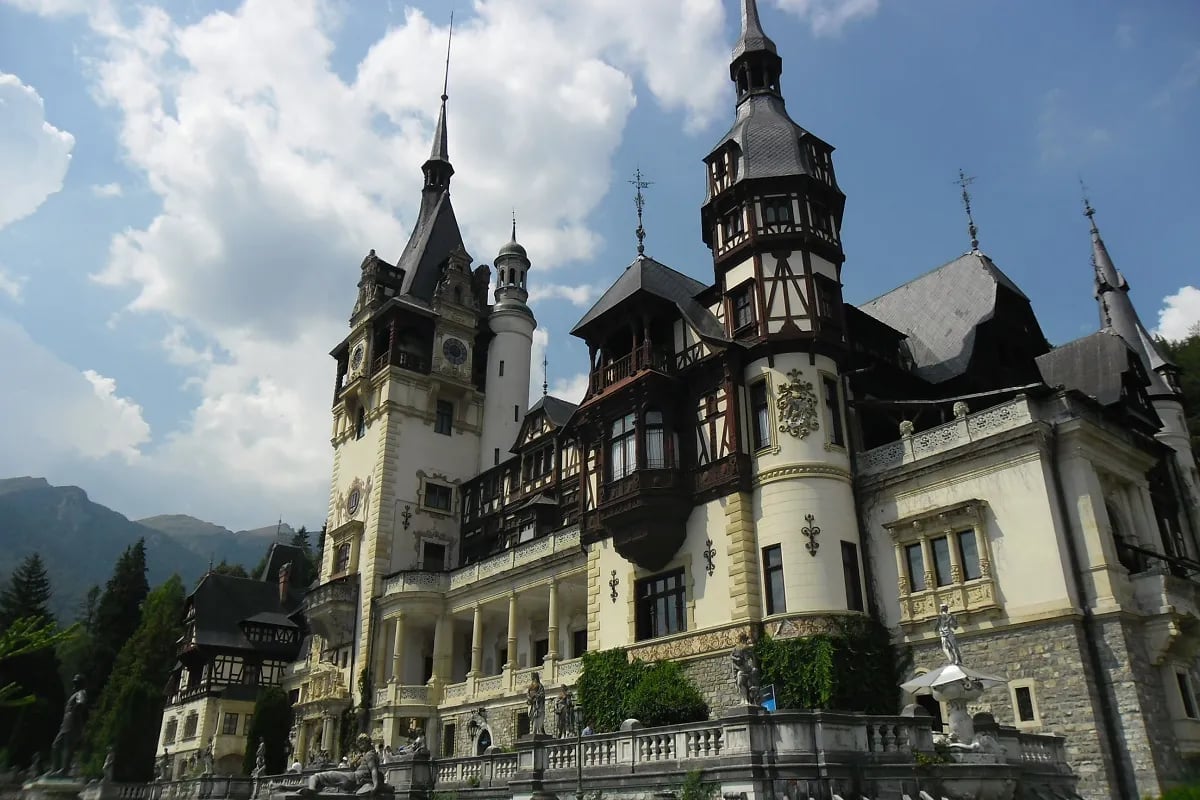
Peleș Castle is one of those places that creates a problem for photographs.
They make it look almost unreal.
A royal residence rising from the forest above Sinaia, elaborate roofs and carved façades against the Bucegi Mountains — it is easy to understand why Peleș appears so often in images of Romania.
But the exterior is not the main reason I would go.
Peleș becomes considerably more interesting once you walk inside and understand what King Carol I was trying to build here.
This was not a medieval fortress.
It was a modern royal residence created during a period when Romania itself was being transformed into a European monarchy.
The architecture, technology, decorative arts and political symbolism all belong to that story.
So yes: Peleș Castle is worth visiting.
And if the castle is open and you have travelled specifically to Sinaia, I would usually make time for the interior rather than stopping at the façade.
The local answer to the questions most visitors ask — before the details.
| Question | Local answer |
|---|---|
| Is Peleș worth visiting? | Yes — particularly for architecture, royal history and interiors |
| Where is it? | Sinaia, in the Prahova Valley |
| Medieval castle? | No — it was created as a nineteenth-century royal residence |
| Who commissioned it? | King Carol I |
| How long inside? | Around 1–1.5 hours works for many visitors |
| How long including grounds? | Around 2 hours is more comfortable |
| Need a timed ticket? | Under current rules, yes |
| Official tickets | Through the Peleș National Museum ticket system |
| Photos inside? | Currently allowed for personal use, with restrictions |
| Direct train to castle? | No — train to Sinaia, then continue uphill |
| Day trip from Bucharest? | Very suitable |
| Peleș or Bran? | Depends on what you want; they are completely different experiences |
| Pelișor too? | Worth considering if royal history particularly interests you |
| Main planning risk | Timed admission combined with unpredictable road traffic |
2026 Peleș visitor update
At the time of publication, Peleș Castle is scheduled to close from 2 November to 1 December 2026 for general cleaning and preventive conservation. Nearby Pelișor Castle is scheduled to close from 28 September to 3 November 2026.
If your trip falls within these periods, check the official Peleș Castle visitor information before travelling. These are temporary closures and should not be treated as permanent opening information.
This distinction immediately improves the visit.
Bran Castle is the place to think about medieval fortress architecture.
Peleș belongs to a completely different Romania.
King Carol I commissioned the residence in the second half of the nineteenth century, during the period in which the Romanian state was developing and eventually becoming a kingdom.
The wider construction and development of the castle continued over several decades.
That explains why trying to give Peleș one simple architectural label does not tell the whole story.
Different architects contributed.
Different decorative influences appear.
Different rooms serve very different purposes.
Peleș was meant to function as a residence, a place of representation and a symbol of monarchy.
You are not entering a defensive fortress. You are entering a political and cultural statement.
Peleș was created at the initiative of Carol I, Romania's first king.
Work began during the 1870s and continued through several stages.
A number of architects contributed to its development, including Wilhelm von Doderer, Johannes Schultz and later Karel Liman, among others.
That matters because Peleș did not emerge from one uninterrupted architectural idea. It evolved.
The royal family's needs evolved.
Technology evolved.
The building evolved with them.
By the time you experience Peleș today, you are seeing the result of decades of additions, decisions and refinement rather than one perfectly fixed design drawn on a single sheet of paper.
Carol I is fundamental to understanding modern Romania.
He came from the Hohenzollern-Sigmaringen family and became ruler of Romania in 1866, later becoming the country's first king in 1881.
His reign was associated with major state-building and infrastructure development.
Peleș belonged to that broader project.
This was a monarch looking toward European institutions, technology and royal culture while ruling a country defining its modern political identity.
That is why the castle makes more sense when seen as more than a beautiful private home. It represented something.
The monarchy wanted Romania to be seen — internally and internationally — as a modern European state. Peleș helped communicate that ambition.
The landscape is part of the answer.
Carol I acquired land in the Sinaia area and chose the mountain setting for his residence.
At the time, Sinaia was itself developing substantially.
The railway through the Prahova Valley would later make the royal destination more accessible and help transform Sinaia into an important resort.
Today, arriving by train makes the journey seem obvious.
In the nineteenth century, the relationship between royal residence, transport infrastructure and the growth of Sinaia was part of a much larger transformation.
Peleș did not simply appear beside an already mature tourism town. Royal presence helped shape the town around it.
Our Sinaia Travel Guide explores that wider story.
Yes. For Peleș, I think the interior is central to the experience.
You can absolutely admire the exterior without entering. The mountain setting is beautiful. The architecture is distinctive. The terraces and surrounding estate give you a strong impression of the residence.
But the inside explains what the outside cannot.
Materials.
Woodwork.
Furniture.
Decorative arts.
Weapons.
Ceremonial spaces. Private rooms. Different artistic influences. The relationship between comfort and representation.
Peleș was designed to communicate status, culture and technological modernity.
That is difficult to understand from a photograph of the roof. If the castle is open and tickets are available, I would go inside.
Do not try to memorise every room name. You probably will not.
Instead, watch for patterns.
Wood is everywhere, but not always used in the same way. Look at carving, panelling, ceilings, doors and furniture.
One room does not necessarily prepare you for the next. Peleș draws on different European decorative traditions. That diversity is part of the experience.
A royal residence needs to perform two functions. People live there. And power is represented there. Ceremonial rooms communicate differently from spaces designed for more personal use.
Weapons, furniture, textiles, paintings and decorative pieces turn the castle into more than architecture.
Look. Travel information can become so detailed that people forget to see the thing they travelled to see.
Yes. Peleș was conceived during an age fascinated by technological modernisation, and the residence incorporated advanced systems for its period.
This fits Carol I's broader interest in infrastructure and modernisation.
You will often encounter spectacular online claims describing Peleș as the absolute "first castle in Europe" to have one technology or another.
Be careful with those sentences. Historical superlatives are very easy to repeat and much harder to prove precisely.
The more important point is well supported: Peleș was designed not as an imitation of a past medieval residence, but as a modern royal home using the technologies and comforts available to an ambitious European court.
That tells you more than a trivia record.
For many visitors:
around 1 to 1.5 hours for the interior is reasonable.
I would allow closer to two hours for the wider Peleș visit if you want to avoid watching the clock.
That gives time for: walking to the castle; arrival procedures; the interior; exterior photographs; the terraces and surroundings; and simply stopping occasionally.
If you add Pelișor, allow substantially more. If you add Sinaia Monastery or the mountain, you are no longer planning a Peleș visit. You are planning a Sinaia day. That distinction helps enormously.
This is one part of the visit I would organise before arriving.
Under the current Peleș National Museum system, tickets are sold for specific visiting intervals.
Official tickets are currently available through the museum's authorised online ticket platform and through SelfPay machines near the monuments.
Use the official Peleș Castle tickets system. Do not assume the first website selling something labelled "Peleș ticket" is the museum.
Under current museum rules, scheduled tickets cannot be reprogrammed or returned for a refund.
That makes the time you choose important. Especially if you are travelling by road from Bucharest.
Because the castle and the road operate according to different philosophies.
The museum gives you a time window. DN1 gives you traffic. Those systems do not negotiate.
On a quiet journey from Bucharest, everything can work perfectly. On a busy weekend or holiday, traffic through the Prahova Valley can turn a comfortable schedule into a stressful one.
This is why I would never build a road trip toward a timed Peleș admission with almost no buffer. Arriving early is mildly inconvenient. Missing a non-refundable timed visit is much more irritating.
If visiting Peleș is important to your trip, I would. Particularly during busy travel periods.
The museum limits access through its timed-entry system and visitor capacity.
You have already travelled to another city. Perhaps from another country. There is little advantage in making the most important part of that day depend entirely on what remains available when you reach the castle.
Buy from the official source. Choose the time carefully. Then organise the day around reality rather than optimism.
Check current Peleș opening hours and ticket prices on the official museum website. Schedules and prices can change.
Under the current museum rules, photography and video are permitted for personal use.
There are restrictions. Flash is not permitted. Selfie sticks are not permitted. Additional lighting is not permitted. Photography or video may also be restricted around particular heritage objects or museum areas.
Check the official Peleș visitor rules before you go because museum policies can change.
There is another important distinction. Permission to take a photograph for personal use does not automatically mean you have commercial publication rights.
If you are producing advertising, commercial media or brand content, check the appropriate permissions separately.
If you have limited time:
Peleș.
That is where I would start.
Pelișor is smaller and creates a more intimate royal experience. It is closely associated with King Ferdinand and Queen Marie and is particularly interesting if Romanian royal history has already become one of the themes of your trip.
Peleș is the stronger first introduction. Pelișor adds depth.
If you have enough time and both are open, they work very well together because the difference in scale and personality becomes part of the story.
But I would not rush through Peleș simply to say that you entered two castles. One properly experienced residence is better than two completed tasks.
This is one of the most common questions about Romania.
And it is almost the wrong question. The castles are so different that comparing them as though they compete for the same experience is misleading.
| Peleș Castle | Bran Castle | |
|---|---|---|
| Main period visitors experience | Modern Romanian monarchy | Medieval fortress + later royal history |
| Original character | Royal residence | Defensive / strategic fortress |
| Strongest story | Carol I and Romanian royalty | Medieval history, Queen Marie and Dracula mythology |
| Interiors | Richly decorative and residential | Narrower, more fortress-like |
| Dracula | No meaningful Dracula identity | Major modern cultural association |
| Setting | Sinaia / Bucegi Mountains | Bran / Transylvanian mountain corridor |
| Best for | Royal history, architecture, interiors | Fortress atmosphere, Dracula, Transylvania |
you care most about architecture, royal history, decorative interiors and the creation of modern Romania.
you care most about medieval atmosphere, Transylvania and the Dracula phenomenon.
visit both. Their differences make the combination much more interesting than either would be if they told the same story.
For the interior experience, I would choose Peleș. For the internationally iconic Transylvania/Dracula experience, I would choose Bran.
For a traveller whose main question is: "Which place teaches me more about the development of modern Romania?" — Peleș.
For someone saying: "I came to Romania fascinated by Dracula and medieval Transylvania." — Bran.
The right choice follows the reason for travelling. Not a universal ranking.
For a deeper Peleș Castle vs Bran Castle comparison, see our dedicated guide.
You have two main approaches: rail or road.
And Peleș is one of those Romanian attractions where independent rail travel is genuinely a strong option.
The train does not take you to the castle door. It takes you from București Nord to Sinaia.
Sinaia lies on the main Bucharest–Brașov railway corridor and direct trains operate between the capital and the mountain town.
Once in Sinaia, you continue uphill toward the Peleș estate.
For many independent travellers, this is an excellent day-trip structure:
Bucharest. Train. Sinaia. Peleș. Monastery or lunch. Train home.
Use the official CFR train planner for the actual date of travel. Different services have different journey times, so there is little value in memorising one supposedly universal duration.
Current CFR schedules continue to show direct București Nord–Sinaia services.
For more train context, see our Romania by Train guide.
Close enough that walking is realistic for many people.
But do not look only at the map. Look at the terrain.
Peleș is uphill.
That distinction matters if you are travelling with: heavy luggage; young children; reduced mobility; poor weather; or a timed ticket approaching rapidly.
A flat kilometre and a mountain-town kilometre can produce rather different opinions about distance.
Walking is one option. Local road transport is another. Choose according to the person actually travelling, not the person who designed the map.
Driving gives you flexibility. It also exposes you to one of Romania's most famous travel variables: DN1 traffic.
The Prahova Valley corridor becomes particularly busy during certain weekends, holidays and mountain travel periods.
So I would not tell you: "Bucharest to Peleș takes exactly X hours." That would be irresponsible planning.
Sometimes the journey is smooth. Sometimes it is not. Check current conditions. Leave buffer time.
And if you have a timed ticket, treat the ticket time as fixed and your road estimate as flexible.
Our Bucharest to Peleș Castle transport guide and Driving in Romania cover the details in depth.
Airport arrival adds variables: flight timing; immigration and baggage where relevant; road traffic; transfer connection; and timed museum access.
Do not purchase a dangerously tight timed castle visit around an arriving flight.
For the full comparison, see Bucharest Airport to Sinaia & Peleș Castle: Train, Car or Private Transfer?
Very. Perhaps one of the best.
You do not need a tour to visit Peleș. A direct train to Sinaia makes the destination relatively straightforward. Peleș has its own official ticket system. The town has enough to fill the rest of the day.
A very sensible independent itinerary can simply be: Peleș. Sinaia Monastery. Lunch. A little time in Sinaia. Train home.
That is already an excellent day. You do not need to attach three more attractions simply because your holiday spreadsheet still has empty cells.
Yes. Road transport makes this much easier than trying to build the day entirely around public transport.
The combination also makes cultural sense. You move from a nineteenth-century royal residence to a medieval fortress internationally associated with Dracula. They do not repeat one another.
But once Bran is added, you are leaving Sinaia and moving toward Transylvania. That changes the scale of the day. Do not underestimate the movement simply because both names contain the word "castle".
Yes. This is one of Romania's classic first-time day journeys.
Peleș gives you Romanian royal history. Bran gives you a completely different fortress experience and the Dracula story. Brașov gives you an actual Transylvanian city. The contrast is excellent.
The day is also long. That trade-off should be stated clearly. If you have one excursion day and want a broad introduction, it works. If you dislike full itineraries and long road days, sleep in Brașov or remove a stop.
Our Royal Castles & Dracula's Legend experience follows the first approach: the complexity of the road and timing is organised privately so the traveller can concentrate on the places.
Yes, but you are combining two very different operating systems. Peleș has timed museum access. The Sinaia mountain installations depend on operational and weather conditions.
That means a perfect schedule designed two weeks earlier may become irrelevant on the morning of the trip.
If mountain conditions are excellent, Peleș plus Cota 2000 can create a beautiful contrast. Royal interiors. Then the Bucegi landscape.
If the upper mountain is in cloud or the gondola is not operating, do not treat that as a failed holiday. Peleș. Pelișor if appropriate. Sinaia Monastery. Town. Lunch. There is still a very good day available.
Our Sinaia Travel Guide explains how to make that decision. And our Sinaia 2000m Alpine Escape offers a curated mountain experience.
Yes. Definitely. If Peleș is closed during your travel dates, the setting does not stop being impressive. The architecture. Forest. Mountain landscape. Royal estate. Sinaia itself. All still exist.
But I would make an important distinction.
If the castle is open, you have time and tickets exist, I would not deliberately choose exterior-only simply because the façade photographs well. The interior is a large part of why Peleș is different.
If the castle is closed, then enjoy the setting and build the rest of the day around Sinaia. The destination does not disappear because one door is locked.
If you visit Sinaia between 2 November and 1 December 2026, the current museum announcement says Peleș will be closed for conservation.
Do not cancel Sinaia automatically.
Depending on the exact date and current conditions, consider: Sinaia Monastery. Pelișor, if open. The town. The mountain, if operations and weather permit. A slower lunch. Or continue farther north toward Brașov.
What you should not do is travel specifically for an interior Peleș visit without checking the museum's current official information first. That is an avoidable disappointment.
It can be. Especially for children already interested in castles, kings, queens or elaborate interiors.
But Peleș is primarily a museum experience. That is different from Bran, where narrow staircases and fortress architecture can create a more immediate sense of adventure.
The correct question is not: "Is Peleș family-friendly?" It is: "How much museum attention does my particular child have today?"
An answer parents generally know better than a travel writer.
This is one area where generic assurances are unhelpful. Historic buildings create physical constraints, and individual needs vary.
The Peleș National Museum provides dedicated accessibility information and currently offers resources including audio and sign-language presentation material.
If mobility, sensory or other accessibility requirements will determine whether the visit works, check the museum's official accessibility information before travelling. Do not base the decision on somebody saying online that the castle was "easy". Easy for whom?
You do not need to memorise an entire museum regulation. But several current rules matter practically.
Photography for personal use is currently permitted, but flash, selfie sticks and additional lighting are prohibited. Food and drinks are not permitted inside museum spaces. Visitors should not touch exhibits.
And under the current visitor rules, once you leave the museum, the exit is final.
Check the official visitor rules before your visit because operational policies can change.
Not necessarily. The museum can absolutely be visited independently.
A guide becomes useful when you want to connect what you are seeing with the wider story. Carol I. Romanian independence. The monarchy. Sinaia. European architectural influence. Modernisation. How Peleș compares with Bran. What happened to the royal residences after the monarchy ended.
That is where interpretation matters. The building supplies the objects. Context connects them.
Not simply because Peleș exists. It makes sense when the day becomes logistically more complex.
For example: Bucharest → Peleș → Bran → Brașov → Bucharest or when hotel pickup matters; several travellers are together; nobody wants to drive; castle timing needs coordinating; the group wants flexibility between stops.
If your plan is simply: Bucharest train → Sinaia → Peleș → train home, independent travel works extremely well.
Use private travel when it removes complexity. Not because every attraction needs to be packaged.
I would book Peleș before travelling. I would avoid the tightest possible arrival time. I would go inside.
I would pay attention not only to how beautiful the rooms are, but to what they were designed to communicate.
Then I would walk outside and stop looking at the castle for a moment. Look at Sinaia. Look at the forest. Look toward the mountains. That landscape is part of why the residence exists here.
Afterwards, I would decide. Do I want more royal history? Add Pelișor. Do I want to understand the town? Visit Sinaia Monastery. Do I want the mountains? Check Cota 2000 conditions. Do I want Transylvania? Continue toward Bran and Brașov.
The mistake would be deciding all four before discovering how the day actually feels.
Peleș Castle is one of the places I would recommend confidently on a first Romania trip.
Not because every famous attraction deserves your time. They do not.
Peleș does because the building gives you access to something larger than itself.
Romania building a monarchy. A king trying to create a modern European residence. Sinaia becoming a royal resort. Architecture being used to communicate culture and power. Technology entering domestic royal life. A country changing.
The exterior gives you the photograph. The interior gives you the story.
If Peleș is open, give it enough time for both.
Common questions
Keep planning
If Peleș is only the beginning of the day, continue with the Sinaia Travel Guide.
If you are comparing Romania's two most famous castles, read the Bran Castle Guide.
If you want to continue into Transylvania, use the Brașov Travel Guide.
If you are deciding which excursion deserves a full day, compare the Best Day Trips from Bucharest.
For airport arrivals and onward planning, see Bucharest Airport to Sinaia & Peleș Castle.
For wider transport and movement, Getting Around Romania and Romania by Train cover your options, and How Many Days Do You Need in Romania? helps with overall planning.
For the classic privately arranged Peleș + Bran + Brașov journey, explore Royal Castles & Dracula's Legend.
If the mountain interests you more than Dracula, explore Sinaia 2000m Alpine Escape.
Romania, privately arranged
Peleș works beautifully as an independent day trip — train to Sinaia, official tickets, monastery and a relaxed route home.
A private day with DACO makes sense when the day becomes more complex: combining Bucharest, Peleș, Bran and Brașov in one carefully timed journey, or pairing Peleș with a mountain experience at Cota 2000.