
Romania Travel Knowledge Hub

Bucharest to Brasov: Train, Car or Private Transfer? How to Choose the Right Way

By DACO Team

Local travel knowledge from DACO Private Travel, Bucharest.

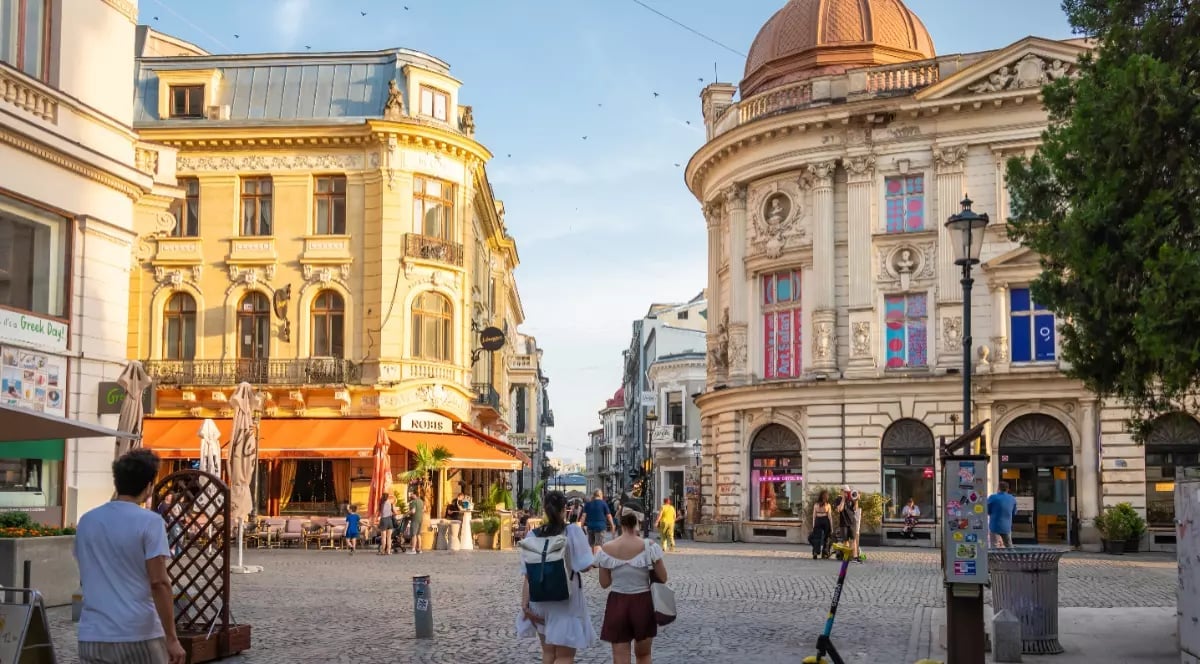
European town square with historic yellow and cream-coloured buildings, domed architecture and pedestrians walking on a cobblestone street in central Bucharest

Bucharest and Brasov are connected in more than one sensible way.

You can take the train.

You can drive.

You can rent a car.

You can arrange a private transfer.

That makes the journey relatively easy to organise.

It also creates the question almost every traveller eventually asks:

Which option is actually best?

There is no useful universal answer.

If you simply need to move from Bucharest to Brasov and the train schedule works well for you, the train may be completely sufficient.

If Brasov is the beginning of a longer Transylvania road trip, a rental car may create useful freedom.

And if you want to leave your Bucharest hotel, travel directly with your luggage, perhaps stop along the way and arrive at your next accommodation without managing stations, parking or driving, a private transfer begins solving a very different problem.

That is the distinction that matters.

The best way from Bucharest to Brasov depends less on the distance and more on what you want the journey to do for you.

If you only need to reach Brasov, keep the question simple

Hotel in Bucharest.

Train station.

Train.

Brasov station.

Hotel.

For many travellers, that can work perfectly well.

There is no reason to manufacture complexity where none exists.

If:

the timetable fits;

your luggage is manageable;

the stations work for your accommodation;

you do not need stops along the way;

and nobody particularly wants a car,

rail can be an excellent choice.

If the train solves the journey cleanly, take the train.

We are comfortable saying that even though DACO operates private transfers.

Because a service should solve a problem. Not invent one.

But Bucharest to Brasov is often not really just Bucharest to Brasov

This is where the decision changes.

A traveller says:

“We are going from Bucharest to Brasov.”

Then the actual plan appears.

Maybe:

“We would also like to see Peles Castle.”

Or:

“Could we stop in Sinaia?”

Or:

“We want to continue to Bran.”

Or:

“Our hotel is outside Brasov.”

Or:

“We have children and several suitcases.”

Or:

“We want to leave when we are ready rather than according to a timetable.”

Now we are no longer comparing identical journeys.

The train still travels between stations.

The private transfer travels around the traveller.

That difference is where the value begins.

Station-to-station and door-to-door are different products

A search result might tell you:

train time;

driving time.

Useful.

Incomplete.

The train journey actually looks more like:

hotel → Gara de Nord → train → Brasov station → accommodation.

A private transfer may look like:

hotel → vehicle → accommodation.

That does not automatically make the transfer better.

But it makes the comparison more honest.

Station-to-station and door-to-door are different products even when they appear in the same search result.

For someone travelling light and staying conveniently near both stations, the difference may be small.

For someone travelling with:

large luggage;

children;

an elderly parent;

a hotel outside the centre;

a late departure;

or an onward plan,

the difference can become much more significant.

Local DACO Note

Before comparing train and car, add the journey from your hotel to the station and from the station to your next hotel. Then compare again.

Sometimes the train still wins.

Sometimes the answer changes.

The train is often the cleanest answer for a clean journey

One origin.

One destination.

No stops.

Flexible enough timetable.

Reasonable station access.

This is exactly where rail deserves serious consideration.

Nobody needs to drive.

Both travellers can relax.

You avoid road traffic uncertainty while the train is moving.

There is no parking problem in Brasov.

You arrive and continue.

For solo travellers in particular, this can be financially attractive.

For couples, both people become passengers.

For travellers who simply dislike driving abroad, the benefit is obvious.

A good train journey removes responsibility.

And responsibility has value.

But the train cannot turn itself into a private itinerary halfway through

This sounds unfair to the train.

It is.

The train is doing exactly what it was designed to do.

But once the journey becomes:

Bucharest → Sinaia → Peles → lunch → Brasov hotel,

the comparison changes.

You can still build that journey using rail and local transport.

Perhaps successfully.

But now the traveller is responsible for:

timing;

luggage;

station transitions;

castle access;

onward train;

the relationship between all those pieces.

A private transfer can absorb much of that complexity into one movement.

That is what you are paying for.

Not simply kilometres.

Adding one stop can change the transport decision more than adding fifty kilometres

This is one of the most useful planning ideas on this route.

Bucharest → Brasov:

simple.

Bucharest → Sinaia → Brasov:

different.

Bucharest → Peles → Bran → Brasov:

different again.

The road did not become dramatically more mysterious.

The journey architecture changed.

Each stop introduces:

timing;

parking;

luggage;

waiting;

entrance coordination;

decision-making.

This is where private transport often becomes much more valuable than its basic distance comparison suggests.

Sinaia changes the equation

Sinaia sits naturally on the wider Bucharest–Brasov corridor.

That makes it very tempting.

And it can be an excellent addition.

But first ask:

Do you actually want Sinaia?

Not:

“Can we fit it?”

Those are different questions.

If you genuinely want to visit Sinaia or Peles Castle, the journey can become part transfer and part experience.

With rail, this may still be possible depending on current connections and how you want to manage luggage.

With a car or private transfer, the movement becomes more flexible.

You can leave Bucharest.

Stop.

Visit.

Continue.

No return to a station simply because the next part of the journey requires one.

Peles with luggage is a different itinerary from Peles without luggage

This is the kind of detail route comparisons often ignore.

Day visitor with one backpack?

Easy to imagine several transport combinations.

Traveller relocating hotels with two suitcases?

Different problem.

Where is the luggage while you visit?

Do you carry it?

Store it?

Return for it?

Does the accommodation help?

Is storage available where and when you need it?

Luggage is not an attraction, but it participates in every transfer.

A private vehicle can make the problem disappear because the luggage stays with the journey.

That is a real service benefit.

Not a luxury adjective.

Private transfer is not simply a more expensive train

This distinction matters.

If all you compare is:

A costs less.

B costs more.

Then the train usually has an obvious advantage.

But a private transfer is buying a different set of conditions.

Potentially:

hotel pickup;

hotel drop-off;

luggage stays with you;

no driving responsibility;

no station navigation;

departure timing built around the traveller;

planned stops;

route adjustments where feasible;

one continuous travel arrangement.

The reason to choose a private transfer is not that trains are difficult. It is that your journey may no longer be a simple station-to-station journey.

That is the honest comparison.

Paying more only makes sense when the extra flexibility solves something

We do not believe:

more expensive = better.

If you are:

one person;

travelling light;

going directly to central Brasov;

comfortable with stations;

happy with the timetable,

a private transfer may provide convenience you do not need.

Then the train can be the better-value decision.

But if the transfer removes:

two taxis;

luggage handling;

a station change;

a fixed departure constraint;

a complicated stop;

driving responsibility,

then you are no longer paying more for the same journey.

You are paying to remove operational work.

That can be worth a great deal.

Convenience is not laziness

This is especially worth saying because experienced travellers sometimes become strangely competitive about inconvenience.

You do not earn more Romania because you carried the suitcase through three transport steps.

You do not become less independent because someone collected you from the hotel.

And you do not become a better traveller because your itinerary cost less while requiring significantly more effort.

Convenience has a legitimate place in travel.

The useful question is:

Which inconvenience are you paying to remove, and does removing it matter to you?

A transfer can turn travel time into usable time

Nobody in the group drives.

Nobody needs to check platforms.

Nobody needs to watch the clock for the next train.

The luggage is handled.

The route is already organised.

That creates a different kind of travel time.

Talk.

Rest.

Look outside.

Ask questions.

Stop thinking about transport for a while.

For some travellers, that is exactly what they are buying.

The value becomes larger for groups

Four people buying train tickets and taking transport at both ends create a different cost equation from one solo traveller.

The private transfer price does not multiply in exactly the same way a per-person calculation does.

This does not automatically make private transport cheaper.

It may not be.

But comparison should be made at the group level, not by looking at one train ticket and one vehicle price.

Especially once you include:

luggage;

station transfers;

time;

shared convenience.

Families value door-to-door differently

Family travel changes the economics of convenience.

Two adults.

Child.

Pushchair.

Suitcases.

Snacks.

Someone suddenly needs a toilet.

The train itself may be easy.

The journeys surrounding the train may be the tiring part.

A private transfer removes several transitions.

That can matter much more to a family than to a solo traveller carrying one cabin bag.

Convenience becomes more valuable when several people have to perform the same connection.

This does not mean every family needs private transport.

It means the same service solves more friction.

For more on family planning, Romania with Children explores the wider picture.

For solo travellers, the train often deserves a stronger look

This is where we should be fair.

Private transfer pricing spread across one traveller can be harder to justify economically.

If the journey is straightforward, train can be a very good answer.

A solo traveller may choose private transfer because:

arrival is late;

luggage is difficult;

they want a specific stop;

their hotel location is awkward;

they simply value door-to-door simplicity.

Fine.

But:

Travelling alone changes the economics of convenience.

If none of those factors matters, we may tell you to take the train.

See also Romania for Solo Travellers for the broader picture.

For couples, the comparison becomes more balanced

Train:

both passengers;

no driving;

often financially efficient;

fixed route and timetable.

Rental car:

flexibility;

freedom after Brasov;

one person drives.

Private transfer:

both passengers;

door-to-door;

greater flexibility;

no driving responsibility;

higher cost.

That is a genuinely useful decision.

There is no universal winner.

The answer depends on what happens after you arrive.

For a fuller view, Romania for Couples covers the wider rhythm of travelling together.

Renting a car is a different kind of investment

If Brasov is the end of your road journey for a few days, you may not need a rental car.

If Brasov is the beginning of:

Bran;

Rasnov;

rural Transylvania;

Sighisoara;

Sibiu;

a wider road trip,

then car rental becomes much more interesting.

You are no longer renting a car for Bucharest–Brasov. You are renting one for what happens after Brasov.

That distinction is important.

The car becomes valuable when the itinerary begins asking questions the railway cannot answer

Can we stop here?

Can we leave later?

Can we take this rural road?

Can we visit two places before dinner?

Can we change tomorrow?

Can we stay somewhere outside town?

These are car questions.

Not train questions.

A train is wonderfully indifferent to spontaneity.

It leaves when it leaves.

That can be liberating.

Or limiting.

Depends entirely on the trip.

Rental car freedom comes with driving responsibility

You gain:

route freedom;

stop freedom;

regional access;

flexibility.

You also gain:

driving;

traffic;

parking;

fuel;

navigation;

rental conditions.

Our Driving in Romania guide explores this in detail.

The key question is not:

“Do we want freedom?”

Everyone wants freedom.

It is:

“Do we want the responsibilities attached to this version of freedom?”

Private transfer gives flexibility without making the traveller the driver

This is its strongest position between train and rental car.

You get more road-based flexibility.

You do not drive.

That can be particularly useful when the day itself contains stops.

For example:

Bucharest pickup.

Sinaia.

Peles.

Lunch.

Brasov.

Now the transport becomes part of the day rather than merely the thing before it.

This is one of the situations where private transfer can become genuinely valuable.

A good private transfer should not feel like you hired a vehicle

It should feel like the transport problem disappeared.

The pickup is clear.

The vehicle is right for the group.

The luggage fits.

The route makes sense.

The driver knows the plan.

Timing is understood.

Stops are agreed.

You arrive.

That is the service.

The vehicle matters.

The organisation matters more.

The transfer should not become the attraction

This is equally important.

You are going to Brasov.

Maybe Sinaia.

Maybe Peles.

Maybe Bran.

The driver is not the protagonist.

The car is not the protagonist.

DACO is not the protagonist.

The journey belongs to the traveller.

Good transport removes friction quietly enough that the traveller remembers:

the castle;

the road;

the mountains;

the conversation;

Brasov.

Not the logistical structure that made those things possible.

The road has a timetable too. It simply does not print one.

This route deserves some humility.

A map may show one driving estimate.

Reality includes:

traffic;

time of day;

weekends;

holiday periods;

weather;

roadworks;

incidents;

seasonal movement toward mountain areas.

A road journey that feels straightforward at one time can behave differently at another.

That does not make the road unreliable.

It makes it a road.

Departure time matters

A private transfer creates departure flexibility.

That does not mean:

leave whenever and road conditions no longer matter.

Choosing departure time intelligently can still improve the journey.

If the day includes Peles or other timed attractions, those opening conditions matter too.

A good transfer plan considers the day as a whole.

Not only pickup time.

Flexibility is most valuable when it has somewhere useful to go

There is little value in saying:

“You can stop anywhere.”

if you do not actually want to stop anywhere.

Flexibility becomes valuable when the itinerary contains:

a place;

a meal;

a view;

a castle;

a hotel check-in;

a change of plan.

Otherwise it is simply unused capacity.

We would rather define the route properly than sell flexibility as an abstract luxury.

Bucharest to Brasov with Peles is no longer just a transfer

It becomes something between:

transport;

route planning;

travel day.

This is where language matters.

If you book a simple transfer, expectations should be simple.

If you want:

Peles visit;

waiting time;

additional stop;

different route;

another attraction,

that needs to be clearly arranged.

No traveller should discover the difference halfway through the journey.

Clear inclusions are part of hospitality.

Bran changes the day even more

This is important.

Brasov and Bran are closely connected in travellers' minds.

Transport does not treat them as the same place.

If you want:

Bucharest → Bran → Brasov,

or:

Bucharest → Peles → Bran → Brasov,

you are now building a multi-stop road itinerary.

That is very different from:

Bucharest → Brasov.

A private car becomes significantly more useful because the stops are the journey.

Train to Brasov. Bran is another question.

This deserves its own answer.

You can reach Brasov by train.

Then Bran requires another transport decision.

Perhaps:

bus;

taxi;

ride-hailing where useful;

tour;

rental car;

private transfer.

Reaching Brasov by train and exploring the area around Brasov are two different transport problems.

A visitor only interested in Brasov may need nothing else.

A visitor using Brasov as a base for Transylvania may.

Brasov is not merely the waiting room for Bran Castle

This matters editorially.

Brasov deserves time.

Old streets.

Squares.

Views.

Restaurants.

Neighbourhoods.

A different rhythm from Bucharest.

If your itinerary treats Brasov purely as:

station → quick centre → Bran → leave,

you may technically have visited.

But you have also turned a city into a logistics point.

Brasov is not merely the waiting room for Bran Castle.

Sometimes the better transport decision is the one that leaves enough time to notice where you arrived.

A day trip and a relocation are not the same journey

Bucharest → Brasov → Bucharest.

Different from:

Bucharest → Brasov → hotel.

The first has a return journey attached.

That changes:

time pressure;

amount of sightseeing;

transport tolerance;

value of stops.

The same road becomes a different travel decision when you have to come back before bedtime.

This is why day-trip advice should not be copied directly onto a one-way relocation.

Can Brasov be visited as a day trip from Bucharest?

Yes, depending on the chosen transport, current conditions and what you want from the day.

The better question is:

What kind of Brasov day do you want?

City only?

Brasov + Bran?

Brasov + Peles?

All three?

Lunch?

Walking?

Time to sit somewhere?

The more additions, the more the day becomes a schedule rather than a visit.

A day can contain Brasov. The better question is how much of Brasov the day leaves you able to notice.

Private transport becomes stronger as the day gains stops

One transfer:

Bucharest → Brasov.

Train competes extremely well.

Three or four movements:

Bucharest → Peles → Bran → Brasov.

Now the value equation changes.

Why?

Because one vehicle can carry:

travellers;

luggage;

timing;

route continuity

through the entire day.

You remove repeated transport resets.

That is exactly where private service becomes more than simple transportation.

The vehicle becomes temporary infrastructure

This is particularly useful during relocation days.

You check out in Bucharest.

Everything is with you.

You want to visit something before checking into Brasov.

Without a continuous vehicle, luggage becomes a question.

With one:

it stays in the vehicle while the agreed journey continues.

That creates freedom between hotels.

For multi-stop transfer days, this can be one of the biggest practical advantages.

The driver can also remove small pieces of uncertainty

Where exactly do we stop?

Which entrance?

Where do we continue from?

How long do we realistically have?

Is the timing still sensible?

These are minor questions individually.

Across a full day, they accumulate.

A good professional driver or driver-guide reduces them.

Not by controlling the traveller.

By keeping the operational side from becoming the traveller's job.

This is where local knowledge should earn its place

Not through:

“We know Romania better than you.”

That is not useful.

Useful local knowledge sounds like:

“If you want to include this stop, leaving at this time will make the day calmer.”

Or:

“This combination is technically possible but will make Brasov very rushed.”

Or:

“If Brasov is the priority, I would remove Bran today.”

That is much more valuable than simply saying yes to everything.

Sometimes a good transfer plan contains fewer stops

This is important commercially too.

Private transport gives you capacity.

That does not mean you should consume all of it.

Peles?

Bran?

Rasnov?

Lunch?

Viewpoint?

Brasov?

Possible does not mean wise.

A good private journey should use flexibility to create a better day.

Not to turn the day into a collection exercise.

We would rather remove a stop than sell an exhausted itinerary

That is our planning standard.

If the traveller's priorities are:

Peles and Brasov,

then perhaps that is the day.

If Bran matters more:

perhaps build around Bran.

If all three truly matter:

accept the longer day and understand the rhythm.

The transfer should create flexibility.

It should not become an excuse for overplanning.

Private does not mean unlimited

Another useful distinction.

Private transport means:

more adaptable;

more direct;

more personal.

It does not mean:

time disappears;

roads shorten;

attractions stay open longer;

traffic obeys your booking.

Good private travel remains attached to reality.

We prefer that.

A driver-guide and a simple transfer are not automatically the same service

This should always be clear.

Traveller expectations matter.

Do you need:

transport only?

planned stops?

waiting?

guidance?

a full tour?

The commercial structure should match what the traveller actually wants.

A simple transfer should not be disguised as a tour.

A multi-stop touring day should not be priced or described as though it were simple transportation.

Clarity protects both sides.

One of the advantages of private transport is that the route can belong to the traveller

Not to the timetable.

This is where the model becomes especially strong.

Want an earlier start?

Potentially.

Want to stop in Sinaia?

Arrange it.

Need more luggage capacity?

Choose the right vehicle.

Travelling with children?

Plan accordingly.

Want to go directly to a rural accommodation instead of central Brasov?

That can be built into the journey.

The road becomes useful because it can follow the shape of the trip.

But flexibility should be agreed, not assumed

This is another trust point.

A traveller should not hear:

“private transfer”

and assume:

unlimited waiting;

unlimited changes;

unlimited kilometres;

all attractions;

anything at any time.

The correct arrangement should explain:

route;

included stops;

waiting where relevant;

vehicle;

price structure;

what changes the agreement.

Transparent flexibility is better than vague flexibility.

What would we choose for a simple Bucharest–Brasov relocation?

If we were advising a traveller who told us:

one or two people;

normal luggage;

central Bucharest;

central Brasov;

no stops;

comfortable using rail;

timetable works,

we would seriously consider the train.

There may be little value in paying more simply to reproduce the same movement by road.

This is exactly where a travel company should be willing to say:

you may not need us.

When would we start recommending private transfer more strongly?

The equation changes when several of these appear:

significant luggage;

family or group;

hotel-to-hotel simplicity matters;

departure needs to follow your schedule;

Sinaia or Peles stop;

Bran or another regional stop;

rural accommodation;

late or awkward timing;

you do not want to drive;

several transitions would otherwise be required;

the journey itself is intended to be part of the day.

Now private transfer starts solving multiple problems at once.

That is where it becomes powerful.

When would we recommend rental car instead?

If:

you want the car for several days after Brasov;

regional flexibility matters;

you are comfortable driving;

you want spontaneous stops;

your itinerary becomes increasingly rural.

Then rental can offer better value than repeatedly arranging individual transfers.

We do not need to own every kilometre.

The right answer matters more.

For road flexibility over several days, you can also explore our Rent a Car option.

When would we still recommend the train?

Direct movement.

Suitable timetable.

Simple luggage.

Good station access.

No meaningful stops.

Price sensitivity.

Solo traveller.

Or simply:

you prefer trains.

That is enough.

A travel company should not make an easy journey sound difficult simply because difficulty is easier to sell.

That principle matters more than one booking.

Local DACO Note

If Brasov is where you stop travelling for the day, train logic may be enough. If Brasov is where your Transylvania itinerary begins, ask what happens next.

The answer after Brasov often decides the transport before Brasov

Ask:

Where am I sleeping?

What am I doing tomorrow?

Do I need a vehicle again?

Is Bran involved?

Sighisoara?

Sibiu?

Rural accommodation?

Do I want to drive?

Do I want someone else to manage the movement?

A transport decision becomes much clearer when it belongs to the itinerary rather than to one line on the map.

For the wider view, Romania by Region and How to Plan a Romania Itinerary Without Trying to See Everything help connect the transport to the shape of the whole trip.

Bucharest to Brasov can also be the beginning of a private Transylvania journey

This is where a simple transfer can evolve naturally into something more useful.

Rather than thinking:

How do we get to Brasov?

The real question may become:

How do we want to enter Transylvania?

Directly?

Via Sinaia?

With Peles?

With Bran?

With an overnight in Brasov?

Continue elsewhere?

Once those answers appear, the vehicle is no longer only solving distance.

It is supporting the structure of the trip.

A private transfer should save decisions, not create more of them

We think this is essential.

You should not need fifteen messages while travelling to discover:

where pickup is;

which vehicle;

what is included;

whether the stop is possible;

what happens to the luggage;

where you are going next.

Good planning happens before the wheels move.

Then the traveller gets the benefit: simplicity.

This is the real difference between transportation and arranged travel

Transportation:

move from A to B.

Arranged travel:

understand what A to B actually contains.

Sometimes A to B is simple.

Excellent.

Keep it simple.

Sometimes A to B contains:

a castle;

a hotel change;

children;

four suitcases;

lunch;

a mountain road;

a second destination.

Then organisation matters more.

This is where private travel earns its price.

If your Bucharest–Brasov journey includes hotel-to-hotel travel, significant luggage or planned stops, you can also explore DACO Private Transfers.

For Peles and Bran together in a fuller journey, the Royal Castles & Dracula's Legend experience reflects that multi-stop route.

Common questions

Frequently Asked Questions

If we could give you one Bucharest–Brasov rule

If you only need to reach Brasov, keep the decision simple.

Take the train when the train fits.

Drive when the road gives you something you actually want.

Choose a private transfer when door-to-door simplicity, luggage, flexibility or stops genuinely matter.

And when the journey contains:

Sinaia;

Peles;

Bran;

children;

several suitcases;

a rural hotel;

or the beginning of a wider Transylvania route,

compare the whole day.

Not only the distance.

Because that is where private transport begins doing more than moving you between cities.

It starts removing the invisible work around the movement.

Add Sinaia because you want Sinaia.

Add Bran because you want Bran.

Do not add stops simply because the vehicle can reach them.

And do not turn three sensible transport options into a philosophical problem.

Bucharest and Brasov are connected in more than one good way.

The right one is the one that leaves the journey easier after you arrive.

DACO Team

Local travel knowledge from DACO Private Travel, Bucharest.

Romania, Privately Arranged.

Planning a private journey from Bucharest to Brasov?

If your route includes hotel-to-hotel travel, luggage, children, Peles, Bran or another stop along the way, tell us how you want the day to work. We'll help arrange the road around the journey rather than forcing the journey around the transport.

Request a Private Transfer

Plan My Trip

Prefer the train? Read Romania by Train